
What's inside
- What Makes the Best Hunting Safety Harness Vest
- Quick Comparison: Hunting Safety Harness Vests Compared
- The Six Hunting Safety Harnesses Reviewed
- Buying Guide: The Harness System, Fitted and Rehearsed
- How We Selected These Hunting Safety Harnesses
- Frequently Asked Questions About Hunting Safety Harness Vests
As an Amazon Associate I earn from qualifying purchases. This post may contain affiliate links at no extra cost to you.
The best hunting safety harness vest is the one that gets worn — every climb, every sit, every descent — because the treestand fall statistics that govern this parish share one merciless pattern: the hunters who fall are, in the great majority, not wearing a harness at the moment it happens, and the moment it happens is most often not the sit but the climb, the transition onto the stand, or the descent, when the hunter is moving and the harness is in the pack or hanging unclipped. This guide therefore grades the real, currently sold full-body hunting harnesses on the safety system’s whole sheet, and the word system governs everything that follows: the vest is one component, married to its tether, its tree strap or lifeline, its lineman’s belt for the climb, and its suspension relief straps — the component whose absence turns a arrested fall into a second emergency, since a hunter hanging motionless in leg straps faces suspension trauma on a clock measured in minutes, and the relief strap that lets them stand in a loop and take the pressure off is not an accessory but the second half of the rescue. Standards frame the sheet: buy only harnesses built and tested to the Treestand Manufacturers’ Association’s standards, from the makers who submit to them, sized to the hunter’s actual weight with clothing and gear — a harness is a rated device, and its rating is read like one. Fit is the second specification: the full-body vest designs in this table exist because the old belt-and-chest-strap arrangements were both less safe and less worn, and the vest’s own fitting doctrine — leg straps snug, chest strap at its height, every buckle’s engagement verified by tug — is rehearsed in the buying guide as the commissioning it must be. Comfort is graded without embarrassment as a safety specification: the harness that binds, rides, and freezes its owner is the harness that gets left in the truck by the third cold morning, so padding, ventilation, quiet fabrics for the bowhunter’s close game, and pockets that keep the harness a working vest all enter the grades as the compliance engineering they are. And the frame around the whole article is the one this site keeps for every safety parish: the harness is rehearsed at ground level before it is trusted at height, the stand and its straps are inspected as one system, a hunt plan is left with a person ashore, and the firearm’s own doctrine — unloaded during the climb, hauled by line, muzzle controlled — runs in parallel throughout, because the treestand is where the parish’s two safety cultures, the fall’s and the firearm’s, share a single tree.
The climb doctrine deserves its founding paragraphs, because it is where the statistics live. A harness worn in the stand but unclipped on the climb protects during the safest part of the hunt; the system’s answer is connection from the ground — the lifeline, a rope running the tree’s height with a prusik the hunter slides as they climb, clipped before the first step and unclipped after the last one down — or the lineman’s belt that keeps the installer and the climber married to the trunk while both hands work. Every row in this table is graded as a citizen of that system: its tether’s length and its attachment’s height (the tether should be as short as the sit allows, anchored so the hunter cannot fall below the stand’s platform by more than the system’s design), its compatibility with the lifelines and lineman’s ropes the makers sell as the system’s other halves. The second doctrine is the fall itself, rehearsed rather than imagined: the arrested hunter’s first acts — signal, relieve the leg straps’ pressure with the relief straps or by standing against the tree, and execute the self-rescue or await the planned one — are skills with a ground-level rehearsal this guide prescribes in the same tone as a range drill, because the hunter who has hung in their harness once, two feet off the ground with a friend beside them, owns a calm that the hunter meeting suspension for the first time at twenty feet does not. The third is inspection’s: webbing frayed, stitching pulled, buckles bent, a harness that has arrested a fall — each retires the device or its component parts per the maker’s law, without debate, because a harness is a rated safety device with a service life (the makers commonly counsel replacement on a schedule of years even without incident), and the parish’s economics place the replacement’s price against the alternative without needing the sentence finished.
The vest format’s own argument completes the founding frame. The vest distributes the harness across the shoulders and torso as a garment the hunter puts on like the rest of the morning’s clothing — which is precisely its safety function: the tangle of straps that the old harnesses presented at 5 a.m. in the dark was a compliance tax the vest abolished, and the bowhunter’s vest adds the parish’s refinements — quiet fabrics, the binocular and rangefinder riding on the chest the harness already occupies, the tether’s exit arranged so the draw is unobstructed. Sizing is the format’s discipline: the vest is fitted over the clothing of the coldest hunt it will serve, with the leg straps’ adjustment range proven over the late-season layers, because a harness fitted in September’s shirt is a harness that does not fit in November’s bibs, and the unfitted harness in November is the unworn one. With the system, the climb, and the vest all stated, the table grades the parish’s lifelines.
Our Top Picks
What Makes the Best Hunting Safety Harness Vest
A System, Not a Vest: Tether, Lifeline, Relief Straps
Grade every candidate as the system it will actually be: the vest’s tether length and anchor geometry (short, high, and arranged so a fall is arrested within the design’s few feet), its marriage to a lifeline or lineman’s belt for the climb’s continuous connection, and the suspension relief straps present, reachable, and rehearsed — the component this guide treats as non-negotiable, whether included in the box or bought in the same order and sewn into the routine. A harness sold without its system’s other halves is a chapter, not the book, and the table’s grades credit the makers who package and preach the whole system — the lifeline’s inclusion in so many of the parish’s kits is the industry learning its own statistics in public.
Fit Over the Season’s Clothing
Fit the harness as it will be hunted: over the heaviest layers, seated as in the stand, with the leg straps snug enough to hold their position and the chest strap at the sternum’s height, every adjuster within its range’s middle rather than at its last inch — the fitting that announces a size wrong for November. Weight rating is read with the same honesty: the hunter, clothed, booted, and carrying the pack and the bow, against the maker’s stated capacity, with margin kept. The vest format’s gift is that a correct fit feels like clothing; the fitting session that ends in binding or riding has not found a difficult harness but a wrong size, and the guide’s commissioning step exists to discover that in the shop’s week rather than the season’s.
Comfort as Compliance Engineering
Grade the padding at the shoulders and legs, the fabric’s quietness for the bow stand’s close work, the ventilation for the early season’s heat, and the vest’s working pockets — because each is a reason the harness is on the hunter at the climb rather than in the truck. The quick-release and silent buckles of the better rows serve the dark morning’s dressing; the blaze options serve the gun season’s visibility law where the jurisdiction requires it over the harness. None of this is softness in a safety review: in a parish where the accident’s precondition is the unworn harness, comfort is the hardest safety specification of all, and it is graded here at the head of the sheet where it belongs.
Quick Comparison: Hunting Safety Harness Vests Compared
| Harness Vest | Style / Best For | Key Specs | Typical Price Range | Rating |
|---|---|---|---|---|
| Hunter Safety System Pro Series class | Vest — best hunting safety harness vest overall | Full-body vest, TMA-standard class, relief straps and lifeline ecosystem as published | $110 – $160 | 4.7 / 5 |
| Tree Spider Speed / Micro class | Vest/harness — best lightweight | Minimalist design, quick buckles class as published | $90 – $140 | 4.5 / 5 |
| Summit Safety Harness Pro class | Harness — best value system | Full-body, lineman’s belt inclusion class as published by model | $80 – $120 | 4.4 / 5 |
| Muddy Magnum / Crossover class | Vest/harness — best budget | Full-body designs, padded classes as published | $60 – $100 | 4.2 / 5 |
| HSS Hybrid / Ultra-Lite class | Vest — best bowhunting | Quiet fabrics, bino-harness integration class as published | $100 – $150 | 4.6 / 5 |
| XOP / Hawk Helium harness class | Harness — best saddle-adjacent crossover | Lightweight full-body classes as published by model | $70 – $120 | 4.2 / 5 |
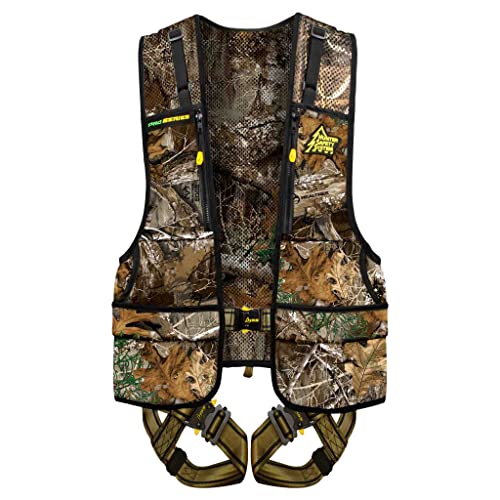
Hunter Safety System Pro-Series Light weight Tree Stand Harness, Camo, L/XL | Light weight tree stand harness, adjustable chest and leg straps, life line connection point, durable webbing hardware
As an Amazon Associate we earn from qualifying purchases. Product prices and availability are accurate as of the date/time indicated.

Kalkal Tree Stand Harness for Hunting, Padded Hunter Safety Harness for Men | Lightweight, Adjustable, Comfortable, All-Season Camo Harness for Tree-Stand, M/L/XL
As an Amazon Associate we earn from qualifying purchases. Product prices and availability are accurate as of the date/time indicated.

Summit Treestands Men's Pro Safety Harness, Large, Green, Model: SU83082
As an Amazon Associate we earn from qualifying purchases. Product prices and availability are accurate as of the date/time indicated.
Ratings are editorial assessments for treestand hunting, based on the makers’ published standards compliance, included system components, and fit ranges, and value at typical prices. Verify your harness is certified to current TMA standards and sized to your clothed weight. Prices are typical retail ranges.
The Six Hunting Safety Harnesses Reviewed
1. Hunter Safety System Pro Series — Best Overall
HSS built the vest parish and its Pro Series remains its reference: a garment the hunter dresses in without a thought, the full system behind it — relief straps, the lifeline ecosystem, lineman’s provisions — and the standards compliance the parish’s founder helped write. Its weight and warmth are the vest format’s known taxes, graded openly; its compliance record — the harnesses actually on the hunters in the statistics’ better half — is the product. For the treestand hunter buying the system once, it is the recommendation this guide writes first.
2. HSS Hybrid / Ultra-Lite — Best Bowhunting
The Hybrid class answers the bow stand’s specific brief: quiet, flexible fabrics that do not announce the draw, the chest arranged for the binocular and the rangefinder the bowhunter consults at ten yards, and the full arrest system beneath the manners. It is the specialist’s vest in the founder’s own line, and the archery parish’s grade for it reflects a harness designed around the draw cycle rather than merely permitted near one.
3. Tree Spider Class — Best Lightweight
Tree Spider’s minimalism serves the mobile hunter — the run-and-gun parish that carries the stand on its back and counts every ounce twice: a harness stripped to the arrest system’s essentials with quick, quiet buckles and a fit that disappears under layers. It concedes the vest’s pockets and padding, announced by its weight; for the hunter whose compliance enemy is bulk rather than straps, it removes the enemy, which is the whole safety argument in this parish.
4. Summit Pro Class — Best Value System
Summit — a stand maker that knows the other half of the system intimately — packages harness value with the lineman’s provisions the climb doctrine demands, at prices that equip the camp. Its finish sits a grade below the founder’s, in exchange for the system’s completeness per dollar. For the new treestand hunter buying stand and harness in one season, it is the rational row, and its grade honours the packaging as the safety feature it is.
5. Muddy Class — Best Budget
Muddy’s harnesses hold the parish’s floor with the standards compliance intact — the floor’s definition in a safety category is a certified device at the lowest honest price, and Muddy’s rows meet it with padding and fit that serve the season’s ordinary hunter completely. The fabrics and buckles are the budget’s, stated in its grade; the arrest system is the parish’s, which is the only sentence that ultimately matters in this table.
6. XOP / Hawk Class — Best Crossover
The mobile and saddle-adjacent makers’ harnesses serve the parish’s growing edge — the hunters who move between the fixed stand, the climber, and the saddle across a season — with lightweight full-body designs whose tether geometries suit several perches. They are graded as crossovers, with the dedicated vest’s comfort a step away; for the mobile hunter whose stand changes weekly, the versatility is the specification, and the rows earn their place on it.
Buying Guide: The Harness System, Fitted and Rehearsed
Step One: Buy the System and the Size Together
Order the whole parish in one decision: the harness sized to your clothed, geared weight with its adjusters mid-range over your heaviest layers; the lifeline for every fixed stand you hunt, or the lineman’s belt where the climbing doctrine requires it; the relief straps confirmed in the box or in the same order; and a haul line and the stand’s own inspection entered in the same sitting, because the system is purchased whole or its weakest morning is purchased separately. Verify the TMA standards mark on the exact model — in a safety category, the certification is the product, and its absence ends the interview.
Step Two: Fit and Rehearse at Ground Level
Commission the harness like the rated device it is: fitted over the season’s clothing by the maker’s sequence — legs, waist, chest, shoulders — every buckle tugged, the tether’s length set so the seated hunter’s fall would be arrested within the design’s distance; then the rehearsal the statistics beg for: clipped in at a foot or two off the ground, weight taken, the relief straps deployed, the self-rescue and the signal performed, with a companion present and the firearm nowhere in the exercise. Practise the climb’s connection — the lifeline’s prusik slid step by step — on the home tree before the season’s dark morning asks for it by feel.
Step Three: Hunt the System, Inspect the System
Hold the season’s liturgies: connection from the ground at every climb without exception — the rule whose phrasing admits no weather, haste, or familiarity amendments; the firearm unloaded and hauled by line, never carried on the climb; the hunt plan left ashore with the stand’s location and the return’s hour; and the inspection at every donning — webbing, stitching, buckles, the tether’s sheath — with the retirement rules (any arrested fall, any damage, the maker’s service-life schedule) executed without debate. Store the harness dry, out of the sun and the chemicals that age webbing, with its log kept. So bought, fitted, and hunted, the chosen harness performs the only service that matters: it is on the hunter at the climb on the season’s coldest, darkest, most ordinary morning — the morning the statistics are made of — and if the worst minute arrives, the system holds, the relief deploys, and the story ends with a shaken hunter telling it, which is the ending the whole parish exists to write.
How We Selected These Hunting Safety Harnesses
We included only real, named, currently sold full-body hunting harnesses from makers who publish TMA standards compliance, weight ratings, and included system components, spanning the vest, bowhunting, lightweight, value, budget, and crossover classes. Prices are typical retail ranges. Grades weight system completeness — tether, climb connection, relief straps — and wearability above fabric features.
Frequently Asked Questions About Hunting Safety Harness Vests
When do most treestand falls actually happen?
Not during the sit — during the transitions: the climb, the step from the ladder or sticks onto the platform, and the descent, when the hunter is moving, reaching, and — in the pattern the accident reports repeat — disconnected from the tree. That is why this guide grades the system rather than the vest: the lifeline that keeps the hunter clipped from the ground to the stand and back, or the lineman’s belt through the climb, is the component aimed at the accident’s actual address, while the harness alone covers the sit and the platform’s own failures. The practical doctrine is a single sentence with no exceptions written into it: you are connected from the moment your feet leave the ground until they return to it, on every climb, in every weather, on the stand you have hunted for ten years — especially on that stand, because familiarity is the risk factor the statistics keep underlining.
What are suspension relief straps, and why are they essential?
They are the second half of the rescue, and their physiology deserves the paragraph: a hunter hanging motionless in a harness has their weight borne by the leg straps, which compress the legs’ great veins; blood pools, circulation fails, and suspension trauma can progress from discomfort to unconsciousness and worse on a timeline that can be measured in minutes — the arrested fall is the beginning of an emergency, not its end. The relief straps are simple loops, carried on the harness or in its pocket, that deploy after a fall to give the hanging hunter a step to stand in, taking the straps’ pressure off the legs and restoring circulation while they signal, self-rescue, or await the planned help. They weigh almost nothing, cost almost nothing, and are graded in this article as non-negotiable — present, reachable by a hanging hunter’s hands, and rehearsed at ground level, because the first deployment cannot be at twenty feet in the dark with the clock already running.
How should a hunting harness fit?
Like the rated garment it is, fitted over the clothing of the coldest hunt: the leg straps snug — a flat hand’s passage, no more — and riding high, the waist belt at the waist, the chest strap at mid-sternum, the shoulder straps even, and every adjuster finishing in its range’s middle over the full layers, because an adjuster at its last inch in November is a size too small wearing a disguise. The seated test is the commissioning’s heart: sat as in the stand, the harness should hold its geography without binding the draw or the breath, and the tether, anchored above, should be short enough that the seated hunter cannot slip below the platform’s level by more than the system’s design intends. The hunter between sizes, or whose season spans a shirt and a bib overall, buys the size that fits the bib — the harness is fitted for the worst morning, like everything else in this parish.
How long does a hunting harness last, and when must it be replaced?
On the maker’s law, which in this category is printed and conservative: the parish’s makers commonly counsel replacement after a period of years in service — often around five — even for a harness that has never arrested a fall, because webbing ages under sun, sweat, and storage in ways the eye under-reports. The immediate retirement rules admit no calendar at all: any harness that has arrested a fall is replaced or returned to its maker per their instructions, its work done and its testimony complete; any webbing frayed, cut, or chemically damaged, any stitching pulled, any buckle bent or cracked, retires the device at the inspection that finds it. The economics are the parish’s simplest: the harness costs less than the deductible on the alternative, and the hunter who writes the purchase date inside the vest’s pocket and honours the schedule has understood that a safety device is a subscription to a standard, not a trophy of a single purchase.
Related guides
- Best Handgun Holster in 2026: 6 Top Handgun Holsters, Concealed Carry Holsters, and Easy Use
- Best Holster Glock 19 Concealed Carry in 2026: 6 Top Holsters Glock 19 Concealed Carry, Glock 19 Holsters, and Easy Use
- Best Concealed Carry Holster for Summer in 2026: 6 Top Concealed Carry Holsters for Summer, Summer Holsters, and Easy Use
- Best Holster for Taurus TH9 in 2026: 7 Best Holsters for Taurus TH9 That Fit Exactly, Cover the Trigger, and Carry Comfortably
More from Amazon
Programs that pair well with the guide above. Offers and eligibility are set by Amazon and may change.
Free shipping on eligible items, Prime Video and more. Eligible new members can start with a free trial.
Start a Prime free trialAudiobooks and podcasts to listen to on the go. Eligible new members can start with a free trial.
Try Audible freeAd-free music streaming. Eligible new subscribers can start with a free trial.
Try Music Unlimited freeA free business account with business pricing and bulk-buying tools for work, shop or home office.
Create a business accountAs an Amazon Associate we earn from qualifying purchases.

Write Your Review
No reviews yet. Be the first to share your experience!