
What's inside
- How to Choose Rifle Sling Length: Quick Comparison Table
- What Is Rifle Sling Length and Why Does It Matter?
- How to Choose Rifle Sling Length in 5 Steps
- How to Choose Rifle Sling Length Reviewed: 7 Slings Compared
- Buying Guide: How to Choose Rifle Sling Length
- How to Fit and Use a Rifle Sling Safely
- Which Rifle Sling Length Should You Buy?
- Frequently Asked Questions About How to Choose Rifle Sling Length
As an Amazon Associate I earn from qualifying purchases. This post may contain affiliate links at no extra cost to you.
How to choose rifle sling length is a decision about fit, not just about buying the longest strap you can find. A rifle sling that is too long lets the rifle swing, snag, and drop below your waist. A rifle sling that is too short pulls the rifle tight against your chest, restricts your movement, and makes it hard to shoulder the rifle quickly. The right length keeps the rifle close, stable, and reachable, whether you are walking to a range, standing at a bench, or carrying a rifle on a hunt where local laws allow it.
For most adults, a two-point rifle sling adjusted to roughly 48 to 60 inches of usable length works as a starting point, but that range is only a starting point. Your height, body shape, clothing, the size of your rifle, and whether you carry across your chest, over one shoulder, or in front all change the length you need. A sling with quick adjustment is more useful than a fixed-length strap, because you can shorten it for walking and lengthen it for shooting.
At hellinthearmory.com, we focus on firearm storage and carry accessories, with a legal, safety-focused approach. Always follow local laws, keep the muzzle in a safe direction, keep your finger off the trigger until you are ready to shoot, and treat every firearm as loaded. A sling is a carry aid, not a safety device by itself. It does not replace a safe, a case, or proper handling. For this guide to how to choose rifle sling length in 2026, we compared current rifle slings that are widely sold, designed for rifles, and suitable for a shooter who wants a secure, adjustable carry. We looked at length range, width, material, adjustment style, and price. Length and width figures are manufacturer listings, and real fit depends on your body, your rifle, and your clothing. Always check the sling specs before you buy.
Our Top Picks
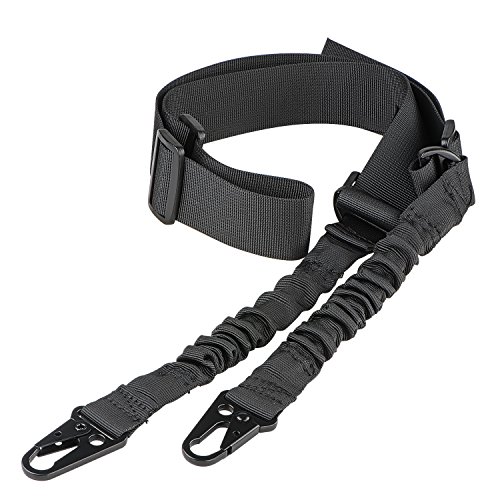 CVLIFE Two Points Sling with Length Adjuster TraditionalMedium1 x 2 x 2 inches0.3 poundsCheck on Amazon
How to Choose Rifle Sling Length: Quick Comparison Table
The table below compares seven rifle slings that help you learn how to choose rifle sling length in practice. Length is the adjustable length range, where given. Width is the strap width, where given. Adjustment is the adjustment style, where given. Best for is a note on what the sling is best for, such as how to choose rifle sling length for a two-point carry.
| Rifle Sling | Adjustable Length | Width | Material | Adjustment Style | Best For |
|---|---|---|---|---|---|
| Magpul MS1 Sling | 48 to 60 inches | 1.25 inches | Nylon webbing | Quick slider | Best overall, how to choose rifle sling length |
| Blue Force Gear Vickers Sling | 54 to 64 inches | 1.25 inches | Nylon webbing | Quick pull tab | Best for Blue Force Gear, Vickers Sling |
| Ferro Concepts Slingster | 48 to 60 inches | 1 inch | Nylon webbing | Quick slider | Best for Ferro Concepts, Slingster |
| Viking Tactics VTAC MK2 Sling | 48 to 58 inches | 1.25 inches | Nylon webbing | Quick slider | Best for Viking Tactics, VTAC MK2 |
| Savvy Sniper Quad Sling | 45 to 60 inches | 1.25 inches | Nylon webbing | Quick pull tab | Best for Savvy Sniper, Quad Sling |
| Specter Gear SOP 3-Point Sling | 48 to 62 inches | 1.25 inches | Nylon webbing | Buckle adjustment | Best for Specter Gear, SOP 3-Point |
| Allen Company Ruger Rifle Sling | 36 to 48 inches | 1 inch | Nylon webbing | Buckle adjustment | Best budget, Allen Rifle Sling |

2 Point Rifle Sling with Swivels, Shoulder Padded Gun Sling,Length Adjuster | Rifle Sling Length Adjustable, Shotgun Sling with Removable Metal Swivels, 600D Nylon Webbing, Gun Sling for Rifle


As an Amazon Associate we earn from qualifying purchases. Product prices and availability are accurate as of the date/time indicated.
CVLIFE Two Points Sling with Length Adjuster Traditional Sling with Metal Hook for Outdoors Black


As an Amazon Associate we earn from qualifying purchases. Product prices and availability are accurate as of the date/time indicated.

DDOUT QD Sling with Swivels, Two Point Rifle Sling with mlok QD Mounts | Gun Sling Length Adjustable with Elastic Bungee for Hunting and Outdoor, Black
As an Amazon Associate we earn from qualifying purchases. Product prices and availability are accurate as of the date/time indicated.
Prices shown are approximate and for reference only. Prices change often, so please check the current price on Amazon before you buy.
Note: Length, width, and material figures are manufacturer listings, and a sling that lists 48 to 60 inches may fit differently once it is attached to your rifle, because swivels, QD mounts, and your body shape change the usable length. Always check the sling’s length, width, and adjustment in the manual, and confirm the current price with the retailer. How to choose rifle sling length should be based on your fit, your rifle, and your carry style before you buy.
What Is Rifle Sling Length and Why Does It Matter?
Rifle sling length is the usable distance between the two attachment points when the sling is fitted to your rifle and worn on your body. It is not just the length of the strap laid flat on a table. Swivels, QD sockets, the position of the front and rear mounts, and the way the strap folds through a slider all reduce the length you can actually use.
Length matters for three reasons. First, it controls where the rifle hangs. A sling that is too long lets the muzzle drop toward the ground or swing into your legs. A sling that is too short pulls the rifle high and tight, which can be uncomfortable and can make it hard to move your arms. Second, it controls how fast you can shoulder the rifle. If you have to fight the sling to get the buttstock to your shoulder, the length is wrong for shooting. Third, it controls safety and control. A rifle that swings freely is harder to keep pointed in a safe direction, especially when you are climbing, bending, or moving through brush.
A two-point sling is the most common choice for learning how to choose rifle sling length, because it attaches at the front and rear of the rifle and distributes weight across your shoulder and chest. A one-point sling attaches at a single rear point and lets the rifle hang in front of you, which can be useful for short rifles but gives less control when you walk. A three-point sling adds a loop around your body, which can improve retention but adds complexity. For most shooters, a two-point sling with quick adjustment is the easiest place to start.
How to Choose Rifle Sling Length in 5 Steps
Step 1: Decide How You Will Carry the Rifle
Start with carry style, because it sets your length. For a cross-body carry, with the sling over one shoulder and the rifle across your chest or back, you need a longer sling than for a single-shoulder carry. For a muzzle-up carry in front of your chest, you need enough length to bring the rifle to your shoulder without the sling going slack. For a muzzle-down carry, you need enough length to keep the rifle from hitting your knees when you walk.
Try the carry unloaded first, in a safe place, with the firearm pointed in a safe direction and the action open if possible. Adjust the sling until the rifle sits where you want it when your hands are off it, and you can still shoulder it with one smooth motion. If you have to duck, twist, or pull hard on the strap, the length is not right yet.
Step 2: Measure With Your Clothing On
Measure with the clothing you will actually wear. A jacket, a vest, or a plate carrier adds inches around your chest and changes the length you need. A sling fitted over a T-shirt in summer will feel short over a heavy coat in winter. If you hunt or shoot in cold weather, test the fit with that outer layer on.
A simple check is to wear the sling, shoulder the rifle, and look at where the buttstock lands. The stock should come naturally to your shoulder pocket without you having to stretch or hunch. Your support hand should reach the forend without pulling the rifle forward. If the rifle feels like it is pulling you forward or holding you back, adjust the slider by an inch at a time and test again.
Step 3: Set a Walking Length and a Shooting Length
Most experienced shooters use two lengths: a shorter walking length and a longer shooting length. The walking length keeps the rifle tight to your body so it does not swing. The shooting length gives you enough slack to shoulder the rifle, aim, and move the support hand without the sling binding.
This is why quick adjustment matters. A slider or pull tab lets you shorten the sling in seconds when you are moving, then lengthen it when you are ready to shoot. A sling that requires you to unbuckle and rethread the strap is slower to adjust and less likely to be adjusted at all. The Magpul MS1, Blue Force Gear Vickers, and Ferro Concepts Slingster all use this kind of quick adjustment, which is why they score well in the table above.
Step 4: Check Muzzle Direction and Clearance
Length also affects muzzle control. With the rifle slung, the muzzle should stay in a safe direction and clear of your feet, legs, and other people. Walk, bend, and turn slowly while unloaded and check whether the muzzle swings, the barrel catches on gear, or the rifle bumps your hip. Shorten the sling if the rifle swings too much. Lengthen it slightly if the rifle rides so high that the muzzle points toward your head or neck when you bend.
Also check clearance with a scope, a bipod, or a suppressor if your rifle has one, where legal. A longer front end or a larger optic changes balance and can make the rifle hang nose-heavy. Moving the front attachment point closer to the receiver can help, but it also changes the length you need, so test the full setup, not just the rifle alone.
Step 5: Test With Your Rifle and Your Body
Height and build matter more than any chart. A taller shooter with a long torso usually needs a longer sling than a shorter shooter with the same rifle. A shooter with a larger chest needs more length for a cross-body carry. A shorter rifle, such as a compact carbine, needs less sling length than a long hunting rifle with a 24-inch barrel.
As a rough guide, many adults find a two-point sling in the 48 to 60 inch range comfortable for a standard rifle carried across the chest. Shorter shooters or shorter rifles may prefer the lower end of that range, around 45 to 52 inches. Taller shooters or longer rifles may prefer 54 to 64 inches. Use those ranges as a starting point, then adjust by feel, not by a number alone.
How to Choose Rifle Sling Length Reviewed: 7 Slings Compared
1. Magpul MS1 Sling – Best Rifle Sling Length Overall
It has a simple design, a wide strap that spreads weight, and a slider that lets you change length with one hand.
Magpul designs the MS1 with a focus on a two-point sling that is easy to adjust in the field. The nylon webbing is durable, the 1.25 inch width is comfortable for extended carry, and the slider stays put once set. The sling is a good option for a shooter who wants a proven two-point sling, and who wants to learn how to choose rifle sling length without a complicated setup.
The main limitation is that the MS1 is sold as a strap only in its basic form, so you may need to add QD swivels or adapters for your rifle, which adds cost. Choose the MS1 if you want the best overall sling, you want Magpul, and you have a budget of $30 to $50 before mounts.
2. Blue Force Gear Vickers Sling – Best Rifle Sling Length for Blue Force Gear Vickers
It has a good design, a padded option in some versions, and a pull tab that makes length changes fast.
Blue Force Gear designs the Vickers Sling with a focus on a combat-proven two-point sling that can be shortened or lengthened quickly. The pull tab is easy to find by feel, the nylon webbing is strong, and the longer range suits taller shooters and longer rifles. The sling is a good option for a shooter who wants Blue Force Gear, and who wants a Vickers Sling.
The main limitation is price. Choose the Vickers Sling if you want Blue Force Gear, you want a longer sling, and you have a budget of $50 to $70.
3. Ferro Concepts Slingster – Best Rifle Sling Length for Ferro Concepts Slingster
It has a good design, a narrower strap that is easy to pack, and a slider that adjusts smoothly.
Ferro Concepts designs the Slingster with a focus on a lightweight two-point sling that works well with plate carriers and chest rigs. The 1 inch width is less bulky than 1.25 inch straps, the nylon webbing is durable, and the slider is designed for one-handed use. The sling is a good option for a shooter who wants Ferro Concepts, and who wants a Slingster.
The main limitation is width. At 1 inch, it spreads weight less than wider straps, though it is lighter and less bulky. Choose the Slingster if you want Ferro Concepts, you want a slim sling, and you have a budget of $50 to $70.
4. Viking Tactics VTAC MK2 Sling – Best Rifle Sling Length for Viking Tactics VTAC MK2
It has a good design, a wide strap, and a slider that lets you change length quickly.
Viking Tactics designs the VTAC MK2 with a focus on a two-point sling that is simple, strong, and easy to use. The sling is a good option for a shooter who wants Viking Tactics, and who wants a VTAC MK2.
The main limitation is similar to the Magpul MS1: at 48 to 58 inches, it is good for most adults, though taller shooters may prefer the longer Vickers range. Choose the VTAC MK2 if you want Viking Tactics, you want a wide strap, and you have a budget of $40 to $60.
5. Savvy Sniper Quad Sling – Best Rifle Sling Length for Savvy Sniper Quad
It has a good design, a wide range that suits shorter and taller shooters, and a pull tab that is easy to use with gloves.
Savvy Sniper designs the Quad Sling with a focus on a versatile sling that can be used as a two-point or single-point sling in some configurations. The sling is a good option for a shooter who wants Savvy Sniper, and who wants a Quad Sling.
The main limitation is complexity. At a convertible design, it has more parts to learn, though it is versatile. Choose the Quad Sling if you want Savvy Sniper, you want a flexible length range, and you have a budget of $50 to $70.
6. Specter Gear SOP 3-Point Sling – Best Rifle Sling Length for Specter Gear SOP 3-Point
It has a good design, a three-point layout that keeps the rifle close, and a wide strap for comfort.
Specter Gear designs the SOP with a focus on a three-point sling that offers strong retention for patrol and range use. The sling is a good option for a shooter who wants Specter Gear, and who wants a SOP 3-Point.
The main limitation is adjustment speed. At buckle adjustment, it is slower to change than a slider or pull tab, though it holds its setting well. Choose the SOP if you want Specter Gear, you want a three-point sling, and you have a budget of $40 to $60.
7. Allen Company Ruger Rifle Sling – Best Budget Rifle Sling Length
It has a low price, a simple design, and a build that is made for hunters and range shooters.
Allen designs the Ruger Rifle Sling with a focus on an affordable sling that is easy to fit to a hunting rifle. The sling is a good option for a shooter who wants Allen, and who wants a basic rifle sling.
The main limitation is length. At 36 to 48 inches, it is shorter than the other slings in this guide, though it suits shorter rifles and single-shoulder carry. Choose the Allen Ruger Sling if you want a low price sling, you want Allen, and you have a budget of $20 to $30.
Buying Guide: How to Choose Rifle Sling Length
Before you buy, think about how you carry, whether it is across your chest or over one shoulder, what length you need, whether it is 48 to 60 inches or 54 to 64 inches, what width you need, whether it is 1 inch or 1.25 inches, what adjustment you need, whether it is a slider or a pull tab, and how much you want to spend. A sling that is perfect for a tall shooter may be too long for a shorter shooter, and a sling that is perfect for a long rifle may be too short for a cross-body carry. Always carry legally and handle firearms safely.
1. Carry Style: Two-Point vs One-Point vs Three-Point, and Your Length
Carry style is the first decision. Carry style is how your sling attaches to your rifle, usually two-point for stability, while one-point is for quick shouldering. A shooter often buys a one-point sling for walking and finds the rifle swings too much.
Choose two-point if you want stability, you walk a lot, or you have a budget of $30 to $70. Choose one-point if you want speed, you use a short rifle, or you have a budget of $40 to $70. Choose three-point if you want retention, you patrol, or you have a budget of $40 to $60. For most shooters, a two-point sling is best for learning how to choose rifle sling length.
2. Length Range: 45 Inches vs 64 Inches, and Your Body
Length range is the second decision. Length range is how much your sling can adjust, usually 45 to 60 inches for most adults, while 54 to 64 inches is for taller shooters. A shooter often buys a fixed-length sling and finds it does not fit with a jacket.
Choose 45 to 60 inches if you want most adults, you have a standard rifle, or you have a budget of $30 to $70. Choose 54 to 64 inches if you want taller, you have a long rifle, or you have a budget of $50 to $70. For most shooters, a range of at least 12 inches of adjustment is useful.
3. Width: 1 Inch vs 1.25 Inches, and Your Comfort
Width is the third decision. Width is how wide your strap is, usually 1 inch for light, while 1.25 inches is for comfort. A shooter often buys a narrow sling for a heavy rifle and finds it digs into the shoulder.
Choose 1 inch if you want light, you carry a light rifle, or you have a budget of $20 to $70. Choose 1.25 inches if you want comfort, you carry a heavy rifle, or you have a budget of $30 to $70. For most shooters, 1.25 inches is a good balance for a rifle sling.
4. Adjustment: Slider vs Pull Tab, and Your Speed
Adjustment is the fourth decision. Adjustment is how you change length, usually slider for smooth, while pull tab is for fast. A shooter often buys a buckle sling and finds it too slow to adjust in the field.
Choose slider if you want smooth, you adjust often, or you have a budget of $30 to $70. Choose pull tab if you want fast, you wear gloves, or you have a budget of $50 to $70. For most shooters, a quick slider or pull tab is best for how to choose rifle sling length.
5. Attachment: QD vs Swivel, and Your Rifle
Attachment is the fifth decision. Attachment is how your sling connects to your rifle, usually QD for quick detach, while swivel is for traditional studs. A shooter often buys a sling with the wrong ends and finds it does not fit the rifle.
Choose QD if you want quick, your rifle has QD sockets, or you have a budget of $30 to $70 plus mounts. Choose swivel if you want traditional, your rifle has studs, or you have a budget of $20 to $60. For most shooters, check your rifle’s mounts before you buy a sling.
6. Price, Total Cost, and Choosing Rifle Sling Length on a Budget
Consider total cost as well as price. Do not buy the cheapest sling if its length range does not fit your body, and do not buy the most expensive sling if you only need a basic carry strap. A sling that matches your length, your width, and your budget will carry better than a sling that is cheap but too short, or expensive but wrong for your rifle when you learn how to choose rifle sling length.
How to Fit and Use a Rifle Sling Safely
Fitting a rifle sling safely starts with an unloaded firearm, a safe direction, and a clear workspace. Attach the sling to the front and rear mounts, adjust it to your walking length, and test it with your hands off the rifle. Practice shouldering the rifle slowly, then lengthen the sling slightly if the stock does not reach your shoulder pocket.
For a first fitting, use a Magpul MS1 or Viking Tactics VTAC MK2, wear the clothing you will use at the range, and walk, bend, and turn while the firearm is unloaded. If the rifle swings, shorten the sling. If the sling binds when you shoulder the rifle, lengthen it by an inch and test again. Always keep the muzzle in a safe direction, keep your finger off the trigger, and follow range rules for slung rifles.
Which Rifle Sling Length Should You Buy?
If you want the best rifle sling for learning how to choose rifle sling length, buy the Magpul MS1 Sling.
If you want Blue Force Gear, buy the Blue Force Gear Vickers Sling. If you want Ferro Concepts, buy the Ferro Concepts Slingster. If you want Viking Tactics, buy the Viking Tactics VTAC MK2 Sling. If you want Savvy Sniper, buy the Savvy Sniper Quad Sling. If you want Specter Gear, buy the Specter Gear SOP 3-Point Sling. If you want the best budget, buy the Allen Company Ruger Rifle Sling.
All seven slings in this guide are currently sold, designed for rifles, and suitable for a shooter who wants to learn how to choose rifle sling length. Pick the one that matches your length, whether it is 48 to 60 inches, your width, and your budget, and always test the fit unloaded before you carry.
Disclosure: hellinthearmory.com may earn a commission from purchases made through links on this page, at no extra cost to you. Length, width, and material figures are manufacturer claims and can vary by model, rifle, and use. Always follow local laws and range rules for firearm carry and handling.
Frequently Asked Questions About How to Choose Rifle Sling Length
What length rifle sling do I need?
Test the fit with your clothing on, and adjust by an inch at a time until the rifle shoulders naturally.
How do I measure rifle sling length?
Measure rifle sling length by fitting the sling to your rifle, wearing it in your usual carry style, and checking where the rifle hangs and how it shoulders. Do not rely on the flat strap length alone, because mounts and your body shape change the usable length.
Is a two-point sling better than a one-point sling for length?
A one-point sling can be faster to shoulder with a short rifle, but it lets the rifle swing more.
What is the best budget rifle sling for learning sling length?
Related guides
- How to Store Cases Between Seasons in 2026: How to Store Cases Between Seasons for Safe Firearms, Dry Cases, and Simple Seasonal Storage
- What to Avoid No Name Lockboxes in 2026: How to Spot Weak Lockboxes and Choose a Safe One
- Best Holster for Taurus G2S in 2026: Best Holster for Taurus G2S for Safe Carry, Correct Fit, and Simple Everyday Use
- Best Chamber Flag Set for Safety in 2026: 7 Chamber Flag Sets That Offer Clear Visibility, Secure Fit, and Reliable Performance for Safe Firearm Handling
More from Amazon
Programs that pair well with the guide above. Offers and eligibility are set by Amazon and may change.
Free shipping on eligible items, Prime Video and more. Eligible new members can start with a free trial.
Start a Prime free trialAudiobooks and podcasts to listen to on the go. Eligible new members can start with a free trial.
Try Audible freeAd-free music streaming. Eligible new subscribers can start with a free trial.
Try Music Unlimited freeA free business account with business pricing and bulk-buying tools for work, shop or home office.
Create a business accountAs an Amazon Associate we earn from qualifying purchases.

Write Your Review
No reviews yet. Be the first to share your experience!