
What's inside
As an Amazon Associate I earn from qualifying purchases. This post may contain affiliate links at no extra cost to you.
The best owb holster with retention is bought by a carrier who has answered the outside-the-waistband question honestly: an OWB pistol rides outside the belt, exposed to the world’s hands, branches, door frames, and gravity in a way no concealed rig ever is, and its holster must therefore hold the firearm against more than a draw. Retention is that holding, engineered in levels: the passive friction of a molded shell, the active devices, thumb breaks, rotating hoods, and locking levers, that must be deliberately defeated before the pistol can move, and the level system by which the parish counts them. This guide compares six real, currently sold OWB retention holsters graded on the retention’s quality rather than its count alone: a device that releases naturally under the draw’s own motion against one that taxes it, security against the grab and the tumble, trigger coverage that is total and rigid, and the belt interface that keeps the whole system planted through a working day. It runs inside this site’s permanent law: carry only where lawful and licensed, open carry’s rules and a venue’s policies verified in advance; the firearm retained in its holster is the carrier’s responsibility in every crowd and every doorway; reholstering is done slowly, visually, with the trigger finger indexed and the muzzle in a safe direction; and any new retention device is rehearsed with an unloaded firearm, verified cleared, magazine removed and chamber checked, until its release is a reflex rather than a research project, because a retention holster’s learning curve must be climbed at home and never in the moment it was bought for.
Learn the levels as a language before the table, since the marketing speaks it loosely. Level I is passive retention, the molded friction and detents of a good Kydex shell, sufficient for the range and the rural parish where the only hand expected on the gun is the owner’s. Level II adds one active device, a thumb break strap, a rotating hood, or a locking mechanism that the draw must defeat as its first motion, and it is the working standard for open carry in public, for duty’s outer parishes, and for any environment where another person’s hand is a scenario rather than a fantasy. Level III stacks a second device atop the first, the duty standard where weapon retention is a trained discipline against a deliberate grab. The levels are not a virtue ladder: each added device is a tax on the draw that training must repay, and the correct level is the one matched to the carrier’s exposure, the range’s Level I, the open carrier’s Level II, the professional’s III, with this guide’s standing warning attached, that retention devices resist the casual grab and the accident superbly and the trained, committed grab only in partnership with the carrier’s own retention technique, which is a skill and not an accessory.
Our Top Picks
 Level 3 Holster for Glock 17/19/19X/23/32/44/45Level 3 Holster1 x 6 x 6 inches0.3 poundsCheck on Amazon
Best OWB Holster With Retention: Levels, Devices, and the Draw’s Tax
The Devices: ALS, Hoods, Thumb Breaks, and Levers
Grade the mechanisms by how they marry security to the draw. Safariland’s ALS, a locking lever released by the thumb’s natural position as the hand takes its grip, is the parish’s benchmark because its release is not an added motion but the draw’s own first inch, security that costs the trained carrier almost nothing in speed. The rotating hood, the SLS pattern, guards the pistol’s rear and the ALS beneath it in the Level III stacks, flipped forward by the thumb in the same economy. The thumb break, leather and Kydex’s elder device, is a strap snapped over the hammer or slide’s rear, released by the thumb’s sweep, honest and proven, with its wear and its snap as its maintenance parish. The finger-lever designs, which ask the trigger finger to release the lock on the draw’s path, carry a controversy this guide states plainly: their detractors associate the motion with the finger’s arrival near the trigger under stress, several agencies and ranges have restricted them, and the carrier considering one should weigh that record and prefer, as this table does, the thumb-driven systems whose release hand is never the trigger hand’s finger. Whichever device, its test is the rehearsal’s: a hundred unloaded draws until the release is invisible, because a retention system that must be thought about in the moment is a lock on the wrong side of the emergency.
Belt, Ride, and the System’s Foundation
The holster’s retention is only as planted as its platform, and OWB platforms fail beginners in predictable ways: the paddle that rocks on a dress belt, the belt loop sized for a belt the carrier does not own, the ride so high or low that the draw’s angle fights the retention device’s release. Specify the system whole: a proper gun belt, stiffened for the load, as the foundation no holster can substitute for; the attachment matched to the day’s constancy, belt loops or a duty mount for the all-day carrier, the paddle reserved for the range’s convenience with its retention audited; and the ride and cant set so the hand’s grip and the thumb’s release arrive together, which is a fitting exercise performed unloaded at home and not a preference guessed from a listing’s photograph. The holster’s own molding belongs in the same audit: rigid coverage of the trigger guard on both faces, a sweat guard that does not interfere with the grip, and retention screws whose tension the owner sets and checks on the calendar, since a Level I’s whole security is a screw’s quarter-turn and the calendar is what keeps it one.
Open Carry, Concealment’s Edge, and the Law’s Parish
Give the carry mode its legal heading, since OWB with retention is most often open carry’s equipment and open carry is a jurisdiction’s specific permission rather than a general one: the states and localities divide on its lawfulness, its licensing, and its venues, and the carrier verifies their own map from official sources before the holster is ever worn in public, with private property’s and employers’ policies riding above the statute in daily life. Retention’s role in that parish is partly legal theater in the best sense: the visibly secured firearm is the carrier’s argument of responsibility to every observer, officer, and fellow citizen who shares the space, and Level II is the floor this guide recommends wherever the public’s hands are a realistic census. The OWB carrier who conceals under a garment inherits a hybrid discipline, the retention still guarding against the garment’s snags and the crowd’s brushes, the draw rehearsed through the cover garment’s clearance until the two motions are one. In every parish the rule of the introduction stands: the holster is a system for keeping the firearm exactly where its owner put it until its owner, and only its owner, decides otherwise, and the law and the hardware are that rule’s two hands.
Best OWB Holster With Retention: Quick Comparison
| OWB Retention Holster Model | Key Specs | Best For | Typical Price Range | Rating |
|---|---|---|---|---|
| Safariland 7378 / 7377 ALS (7TS) | ALS thumb release in class, Level II positioning, SafariSeven material in line | Best owb holster with retention overall | $55 – $85 by fitment | 4.8 / 5 |
| Safariland 6360 ALS/SLS (Level III) | ALS plus rotating hood in class, duty standard positioning, light-bearing options | Best duty Level III | $130 – $190 by configuration | 4.7 / 5 |
| BLACKHAWK T-Series L2D | Thumb-driven release in class, Level II positioning, duty build | Best modern thumb-release alternative | $60 – $90 by fitment | 4.5 / 5 |
| Blade-Tech Total Eclipse / Signature class | Passive retention in class, adjustable friction positioning, modular mounts | Best Level I range OWB | $50 – $80 by model | 4.4 / 5 |
| Comp-Tac International / Warrior class | Passive retention in class, competition heritage positioning, modular in line | Best competition and range | $65 – $95 by model | 4.4 / 5 |
| Galco / DeSantis thumb-break leather class | Thumb-break strap in class, leather construction positioning, classic ride | Best traditional leather retention | $70 – $120 by model | 4.3 / 5 |
Level 3 Holster for Glock 17/19/19X/23/32/44/45, Right-Handed | OWB Paddle Holster, Adjustable Retention, Auto Lock Thumb Release, Duty Open Carry


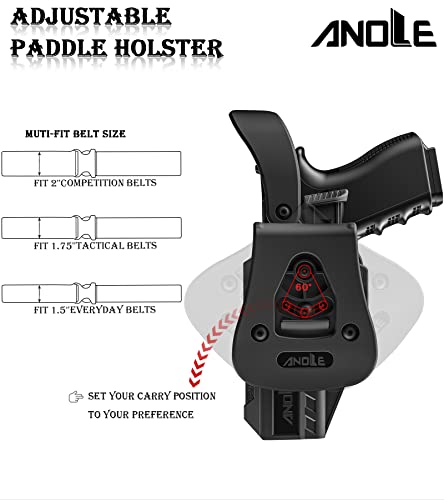


As an Amazon Associate we earn from qualifying purchases. Product prices and availability are accurate as of the date/time indicated.

OWB Level 2 Retention Holster, Pistol Holster Compatible with Glock 17,19,19X


As an Amazon Associate we earn from qualifying purchases. Product prices and availability are accurate as of the date/time indicated.

Bravo Concealment - Holster for Glock™ 19 23 32 19X 45 19MOS 19M - OWB Holster/Adjustable Retention, Outside the Waistband - Comfort and Concealment - EDC - Pistol Holster - Gun Holster


As an Amazon Associate we earn from qualifying purchases. Product prices and availability are accurate as of the date/time indicated.
Prices shown are approximate and for reference only. Prices change often, so please check the current price on Amazon before you buy.
Retention level designations follow the makers’ published classifications; verify fitment for your exact firearm and light combination. Prices are typical US street ranges. Ratings are editorial for OWB retention carry, weighing retention security, draw economy, trigger coverage, belt interface, and value.
The Six OWB Retention Holsters Reviewed
1. Safariland 7378 ALS: Best Overall
The 7378 leads the table on the doctrine’s perfect marriage: an ALS lock that the grip’s own thumb defeats in the draw’s first motion, Level II security in a range-and-carry weight class, and Safariland’s fitment library, which is the industry’s atlas. Its paddle and belt versions serve both parishes. For the OWB carrier buying retention once, it is the recommendation defended first.
2. Safariland 6360: Best Duty Level III
The 6360 stacks the hood over the ALS into the duty standard, the holster against which professional retention is measured, with light-bearing fitments across the service pistols’ parish. Its bulk and price are the profession’s. For the officer and the open carrier in the serious crowd, it is the benchmark wearing a badge of its own.
3. BLACKHAWK T-Series: Best Thumb Alternative
The T-Series is BLACKHAWK’s answer to its own history: a thumb-driven release in the ALS economy’s spirit, a duty-grade build, and a draw that training makes invisible. Its fitment library is younger than Safariland’s. As the modern alternative shortlist of one, it earns its row on merit.
4. Blade-Tech Class: Best Level I
Blade-Tech’s OWB parish serves the range with adjustable passive retention, modular mounts for belt, paddle, and competition rigs, and molding of honest precision. Its security is the friction parish’s, graded as such. For the range and the rural carry where Level I is the matched answer, it is the working standard.
5. Comp-Tac Class: Best Competition
Comp-Tac’s competition heritage shows in draws measured by timers: passive retention tuned to the game’s line between security and speed, with modularity across the match and the range. Its parish is the sport’s rather than the street’s. For the competitor’s OWB, it is the standing order.
6. Thumb-Break Leather Class: Best Traditional
The leather thumb-break closes the table as the elder’s answer: a strap’s honest security in a material that rides quietly and ages gracefully, from the houses, Galco and DeSantis among them, that have made it for generations. Its draw is the deliberate parish’s and its maintenance is leather’s. For the field and the traditional carrier, it remains a living choice rather than a nostalgia.
Buying Guide: How to Choose an OWB Holster With Retention
Step One: Match the Level to the Exposure
Write the carry’s census before shopping: whose hands, branches, and crowds will share space with the pistol, and how often. The range and the ranch answer Level I with a clear conscience; open carry in public and any professional parish answer Level II as the floor; duty against a deliberate grab answers III with its training budget attached. Verify your jurisdiction’s open carry law and your venues’ policies in this step from official sources, since the holster’s legality of use is a local fact. Confirm the fitment for your exact firearm, and for its exact light if one rides, from the maker’s own chart, because retention devices are machined to a silhouette and near-enough is a malfunction scheduled.
Step Two: Build the Platform and Rehearse the Release
Buy the belt with the holster, stiffened and sized to the attachment, and set the ride and cant at home under the rehearsal’s discipline: the firearm unloaded and verified, the draw practiced in the hundreds, slowly and then at life speed, until the thumb’s release and the hand’s grip are a single event and the reholster is its own slow ceremony, eyes on the holster, finger indexed, no garment or thumb-break strap admitted to the trigger guard’s parish. Test the retention as the parish prescribes, the holstered, unloaded pistol held against a shake and an inverted hold over a bed, the screws’ tension set and thread-locked as the maker directs. Any system whose release cannot be made invisible in a week’s rehearsals is the wrong system for this carrier, and the return window exists to be used before the street uses the lesson.
Step Three: Carry It as a System for a Season
Run the rig through its first season as an audited system: the retention device’s function checked weekly against grit and the range’s dust, the screws on the calendar, the leather’s snap or the hood’s pivot maintained as their materials ask, and the carrier’s own retention technique, the bladed stance in a crowd, the elbow’s guard over the butt in a doorway, the awareness that is the device’s senior partner, practiced as deliberately as the draw. Replace the holster when its device wears past crispness rather than when it fails, since retention is a promise whose renewal date should never be discovered. Kept so, the OWB rig becomes what it was bought to be: a firearm that is public property to no one, riding in plain sight and in perfect custody, from the first morning’s belt to the season’s last gate.
Frequently Asked Questions About OWB Retention Holsters
What retention level do I need for open carry?
Level II is this guide’s floor for open carry in public, one active device that must be deliberately defeated, because the open pistol’s census includes every hand in every crowd it passes, and passive friction alone answers none of them. The level is matched upward by exposure: the professional and the genuinely contested environment argue for III with its training; the rural and range parishes argue honestly for I, since a retention device is a tool matched to a scenario rather than a virtue to be maximized. Whatever the level, the device’s partner is the carrier’s own technique and awareness, the stance, the guarding elbow, the refusal to let the strong side be crowded, because hardware resists the grab’s first second and the carrier must own the rest. Choose the level by the census, train it to invisibility, and let no listing’s level claim substitute for the maker’s actual device, read in the description’s words rather than its headline.
Does active retention slow the draw down?
An untrained one does, and a trained one, in the thumb-driven designs that lead this table, costs a margin that practice shrinks toward the negligible, because the release is engineered into the grip’s own motion rather than added before it. The honest accounting is comparative: the draw from a Level II ALS, rehearsed to reflex, stands within a small fraction of the passive draw for the same carrier, while the draw from an unrehearsed anything is slow in the way that matters. The parish’s discipline follows: the retention holster is never carried loaded in the world until its release has been rehearsed unloaded into invisibility, hundreds of draws across the first week, and the carrier who will not pay that tuition should carry the passive rig their training actually supports, since a slower honest draw outranks a faster theoretical one in every encounter ever recorded. Buy the level your calendar will train, and train the level you bought.
Are finger-release holsters like the SERPA safe?
They are the category’s standing controversy, and this guide’s position is to steer the reader to the thumb-driven alternatives that fill this table. The concern, raised by trainers, agencies, and ranges, a number of which have restricted the design, is the release’s location and motion: a trigger finger pressing inward along the frame during a fast draw can, under stress, continue its travel into the trigger guard as the pistol clears, a failure mode whose consequences are written in incident reports rather than in theory. Defenders answer that training prevents it, and trained carriers have used the design for years without incident, which is also true. Between those truths the buyer has a simpler path: the ALS and T-Series class deliver the same Level II security with the thumb doing the releasing, asking nothing of the trigger finger but its discipline. Given an equal alternative without the controversy, this site recommends the alternative, and recommends that any carrier who keeps a finger-release rig train its draw with a seriousness proportioned to the record.
Can I conceal an OWB retention holster?
Yes, within the geometry’s honesty: an OWB rig under a jacket, an untucked shirt, or a vest is concealed carry’s oldest parish, and the retention device serves there against the garment’s snags and the crowd’s brushes exactly as it does in the open. The costs are the rig’s width, which prints more readily than an inside-the-waistband carry and asks the wardrobe’s cooperation, longer and heavier cover garments, a belt line that carries the load without the trousers’ surrender; and the draw, which must be rehearsed through the garment’s clearance until the sweep and the grip are one motion, since a retention release beneath a handful of shirt is a tangle scheduled for the worst moment. The carrier whose concealment is a legal requirement rather than a preference should audit their jurisdiction’s definition, since some laws distinguish the openly carried from the concealed by the garment’s coverage in ways that matter. For the winter carrier and the jacketed professions, the concealed OWB retention rig remains a first-class citizen of this table, provided its rehearsals are as serious as its hardware.
Related guides
- Best IWB Holster for HK VP9 in 2026: How to Pick a Best IWB Holster for HK VP9 That Is Safe, Comfortable, and Perfect for Your HK VP9
- Best Kydex Shoulder Holster in 2026: Alien Gear, Craft, DeSantis, and Fobus Compared for an Exact Shell on a Harness, a Muzzle and Trigger Guard Read as the Rig’s Constitution, and Draws Rehearsed Unloaded Longer Than Any Other Parish
- Best OWB Holster for Glock 17 in 2026: 7 OWB Holsters That Offer Full Trigger Coverage, Fast Draw, and Reliable Retention for Glock 17
- Best Concealed Carry Holster for Springfield XDS 45 in 2026: 7 Concealed Carry Holsters That Offer Full Trigger Coverage, Comfortable Concealment, and Reliable Retention for Springfield XDS 45
More from Amazon
Programs that pair well with the guide above. Offers and eligibility are set by Amazon and may change.
Free shipping on eligible items, Prime Video and more. Eligible new members can start with a free trial.
Start a Prime free trialAudiobooks and podcasts to listen to on the go. Eligible new members can start with a free trial.
Try Audible freeAd-free music streaming. Eligible new subscribers can start with a free trial.
Try Music Unlimited freeA free business account with business pricing and bulk-buying tools for work, shop or home office.
Create a business accountAs an Amazon Associate we earn from qualifying purchases.



Write Your Review
No reviews yet. Be the first to share your experience!