
What's inside
As an Amazon Associate I earn from qualifying purchases. This post may contain affiliate links at no extra cost to you.
A car safe exists for a narrow, important job: securing a handgun, and sometimes other valuables, inside a vehicle for the limited times when lawful temporary storage in that vehicle is necessary, such as entering a building where carry is prohibited, where the law of your jurisdiction permits vehicle storage and prescribes how it must be done. It is not a glove box, it is not a center console, and it is not a long-term storage plan. A vehicle is one of the most targeted places for theft, it experiences extreme heat and cold, and it can be taken in its entirety. The best car safe is therefore the one that is strong for its size, positively secured to the vehicle’s structure so the whole safe cannot simply be carried away, quick for you to use correctly, and matched to a routine that minimizes the time a firearm spends in a car at all.
This guide explains how to choose a car safe for lawful, safety-focused use, comparing real, currently sold vehicle and portable safes by lock type, steel and cable or bolt-down security, size and vehicle fit, and interior protection. It covers the legal frame first, because vehicle firearm storage is regulated differently in different states, cities, and situations, and some places prohibit it or require a locked container of a specific type, an unloaded firearm, separate ammunition storage, or a location in the vehicle that you must verify before you buy anything. Always follow all applicable federal, state, and local laws and the rules of any employer, school, government, or private property you visit, verify a firearm is unloaded by removing the magazine and checking the chamber visually and physically before handling it for storage practice or cleaning, maintain muzzle awareness during all handling, and never leave a firearm in a vehicle longer, or in a place, or in a condition, that the law and ordinary prudence forbid. A car safe reduces a risk. It does not eliminate it, and it never makes an unlawful storage lawful.
Our Top Picks
 Grimtron Portable Electronic Car Gun Safe for Handgun11.02 x 7 x 1.85 inches11.02 x 7 x 1.85 inches3.7 poundsCheck on Amazon
Car Safe Basics: Law, Securing the Safe, and Lock Types
The Legal and Safety Frame Comes Before the Product
Vehicle storage law varies more than almost any other part of firearm storage. Depending on jurisdiction and circumstance, the law may address whether a firearm in a vehicle must be unloaded, whether ammunition must be stored separately, whether the container must be locked, hard-sided, or secured to the vehicle, whether it may be in the passenger compartment or must be in a trunk or locked area, and whether particular destinations change what is permitted. Permits, employment, and whether a vehicle is attended also matter in many places. This guide cannot state the law for your situation, and a product description that calls a safe legal or compliant does not settle the question for your state, city, or trip across a state line, where the rules can change under your wheels.
The safety frame is constant even where the law differs. Plan your day to minimize vehicle storage: carry lawfully where you may, leave the firearm in proper home storage when a trip is built around prohibited places, and use the car safe for the shortest necessary interval when no better lawful option exists. Park and behave with the safe’s presence in mind, without advertising it: no handling of a firearm in public view in a parking area, no safe or cable visible to invite attention, and no valuables left in sight that make your vehicle a target for reasons beyond the safe. If a vehicle will be serviced, valeted, borrowed, or left for days at an airport or lot, a car safe is the wrong storage for that interval. Move the firearm to lawful home storage beforehand, handled and transported as the law requires.
A Car Safe Must Be Secured to the Car
The defining feature of a real car safe is not its lock. It is its attachment. A strong box sitting loose under a seat is a gift-wrapped firearm for a thief who breaks a window, because the entire safe leaves in seconds and can be opened later without time pressure. Vehicle safes secure in two main ways. A steel security cable loops around a fixed structural point, most commonly a seat frame rail or another manufacturer-identified solid anchor, and locks to the safe. Cable systems are portable between vehicles, need no drilling, and suit a driver who changes cars or uses a rental where lawful, provided the anchor point is genuinely structural and the cable cannot be slipped off the end of the rail. Bolt-down systems fasten the safe to the floor, a console structure, or a trunk surface with hardware, and offer the strongest resistance to removal in a dedicated vehicle, at the cost of installation work, permanence, and the need to confirm you are not drilling into wiring, fuel, or structural elements the vehicle maker forbids.
Test your chosen attachment as an adversary’s first move. Pull the safe firmly in every direction it could be pulled, try to work the cable off its anchor, and check whether the safe can be positioned so its door or lid can be pried against a seat or floor edge. Install the safe where it is concealed from outside view, reachable by you without conspicuous public handling, and clear of seat travel, airbag deployment zones, pedals, and any vehicle control or safety system. Follow both the safe maker’s and the vehicle maker’s guidance, and if a correct installation is beyond your tools or confidence, a reputable installer or locksmith is a sensible cost, because an incorrectly anchored premium safe is weaker than a correctly cabled basic one.
Lock Types for Vehicle Use: Key, Combination, Electronic, and Biometric
Each lock type behaves differently in a hot, cold, dark vehicle. A key lock is simple, needs no battery, and works with gloves, provided the key is carried securely by you and never left in the vehicle, in a spare location a thief would check, or on a ring that identifies what it opens. A mechanical combination or push-button lock needs no battery or key and is a strong vehicle choice for owners who will practice its operation until it is reliable by feel, because a combination fumbled in a dark footwell invites exactly the public handling you are trying to avoid. An electronic keypad is fast and can offer a light and multiple codes, and it introduces batteries that heat, cold, and time degrade, so it demands a replacement schedule and a tested backup key. A biometric lock is fastest for its enrolled owner in good conditions and most sensitive to the vehicle’s real conditions: wet, cold, dirty, or gloved fingers, and a sensor used at an awkward under-seat angle. In a car, more than anywhere else in storage, your backup method is not a detail. It is half the product.
Choose the lock you will operate correctly every time, under time pressure, in the dark, in winter, after rain. Then practice the entire routine, with an unloaded, verified firearm or a training replica, in your own driveway: park, secure, store, lock, leave, return, and retrieve, until every step is quiet, unhurried, and invisible. A routine that requires rearranging the car, opening doors wide, or explaining itself to onlookers is a routine that will be skipped, and a skipped safe is worse than a simpler safe used without exception.
Car Safe: Quick Comparison
| Car Safe Model | Key Specs | Best For | Typical Price Range | Rating |
|---|---|---|---|---|
| Vaultek LifePod 2.0 (Keypad / Biometric versions) | Weatherproof portable safe case, built-in lock and steel cable system, key backup, electronic lock versions | Best car safe overall for portable vehicle use | $130 – $250 by version | 4.6 / 5 |
| Snapsafe Lock Box XL | Steel lock box, key lock, included steel security cable, foam interior, sizes for larger handguns | Best simple key-lock car safe | $35 – $55 | 4.4 / 5 |
| Hornady RAPiD Vehicle Safe | Vehicle-mounted safe, RFID and keypad access by system, inflatable bladder or mounting system by version, backup key | Best dedicated mounted vehicle safe | $300 – $380 | 4.4 / 5 |
| Fort Knox Original Pistol Box (PB1) | Heavy steel handgun box, mechanical push-button lock, gas strut door, pre-drilled mounting holes for bolt-down use | Best bolt-down mechanical car and home safe | $260 – $320 | 4.7 / 5 |
| Vaultek VT20i (with vehicle cable securing) | Biometric, keypad and key safe, rechargeable system, steel cable and mounting options | Best biometric option for a dedicated vehicle | $220 – $280 | 4.5 / 5 |
| Stopbox USA Handgun Retention Device / Chamber Lock Range | Mechanical handgun retention and lock devices, no batteries, rapid mechanical access designs by model | Best battery-free alternative for lawful vehicle routines | $100 – $200 by model | 4.1 / 5 |
| Titan Gun Vault Titan Compact Vault | Steel handgun vault, mechanical lock design, mounting bracket systems for vehicle and home by version | Best mounted mechanical vault for a fixed vehicle | $280 – $360 by version | 4.5 / 5 |

AIRMuch Biometric Gun Safe for Handguns, Pistol Safe Fits 2-3 Handguns | Fingerprint Gun Safe for Handguns, Car Gun Safe with Quick Access, LED Light, Stealth Mode, Carbon Steel
As an Amazon Associate we earn from qualifying purchases. Product prices and availability are accurate as of the date/time indicated.

Amazon Basics Portable Security Case Lock Box Safe with Combination Lock for Documents, Valuables, Personal Items, Dorm Room, Home, Large, Black
As an Amazon Associate we earn from qualifying purchases. Product prices and availability are accurate as of the date/time indicated.
Grimtron Portable Electronic Car Gun Safe for Handgun with Security Cable | Small Gun Lock Box with Silent Mode & Emergency USB Power Supply, Single Pistol Safe for Travel, Vehicle, Truck, Nightstand


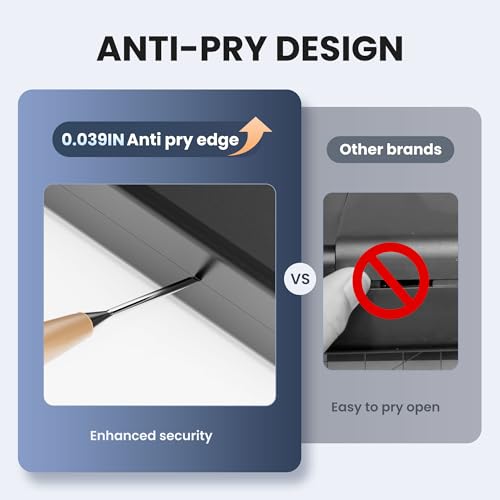


As an Amazon Associate we earn from qualifying purchases. Product prices and availability are accurate as of the date/time indicated.
Prices shown are approximate and for reference only. Prices change often, so please check the current price on Amazon before you buy.
Steel, lock, cable, mounting, and interior specifications follow each manufacturer’s current listing for the exact model and version, and legal compliance depends on the buyer’s jurisdiction and use, not on the product alone. Prices are typical US street ranges. Ratings are editorial, weighing attachment security, lock reliability in vehicle conditions, construction, fit, and value.
Reviews: Which Car Safe Fits Your Vehicle and Routine?
1. Vaultek LifePod 2.0 and SnapSafe Lock Box XL: Best Portable Choices
The LifePod 2.0 earns the portable recommendation because it was designed for exactly this life: a sealed, weather-resistant case with a built-in locking and cable system that moves between a vehicle, a boat, and lawful travel, with electronic access and a key backup in one unit. Choose its biometric version only if you will test it at the vehicle’s angles and conditions, and its keypad version if you value glove and weather reliability over fingerprint speed. The SnapSafe Lock Box XL is the honest simple answer: steel, foam, a key, and a proper cable, at a price that removes every excuse for using a glove box. Its key discipline is its whole system, so carry the key on your person and keep the spare at home, never in the car.
2. Fort Knox PB1 and Titan Compact Vault: Best Bolt-Down Mechanical Safes
These two safes serve the dedicated vehicle, or a vehicle-and-home pattern, where a permanent installation is possible and justified. The Fort Knox PB1 brings heavy steel and a mechanical push-button lock that no battery, heat wave, or cold snap can disable, in a box made to be bolted down and used for years. The Titan offers a similarly mechanical philosophy with mounting bracket systems designed for fixed positions. Either is more safe than a portable user needs and exactly right for a driver whose lawful routine genuinely requires regular vehicle storage in the same vehicle. Budget for correct installation, and confirm the mounted position does not interfere with seats, airbags, or vehicle service access before the first hole is drilled.
3. Hornady RAPiD Vehicle Safe and Vaultek VT20i: Best Powered Access
The Hornady RAPiD Vehicle Safe is purpose-built for a mounted position with fast electronic and RFID access for its owner, and it suits a fixed vehicle and a practiced routine where its mounting system fits correctly. The VT20i, cabled or mounted in a dedicated vehicle, brings the biometric, keypad, and key system of a good home quick-access safe into the car, with the same condition stated in the biometric section: test the fingerprint method in the car, in the cold and the wet, and treat its keypad and key as equal methods, not afterthoughts. Powered vehicle safes need a battery calendar, written down and kept, because a vehicle is the harshest battery environment most owners own.
Buying Guide: How to Choose a Car Safe
Step One: Confirm the Law, the Vehicle Fit, and the Anchor Point
Begin with your jurisdiction’s current vehicle storage rules from an official source, and with the rules of the places your routine involves, and do not proceed on the basis of a forum, a listing, or another state’s practice. Then measure. With the firearm verified unloaded, or with its manufacturer’s stated dimensions, confirm the safe’s interior fits the firearm as carried, including any optic or light, without forcing the door, and confirm the safe’s exterior fits its intended vehicle position with the door able to open fully and the seat able to move through its normal travel. Identify the exact anchor: a seat rail or structural point for a cable, or a bolt-down surface the vehicle maker permits, and reject any position near airbag zones, wiring runs, fuel components, or controls.
Decide portable or permanent honestly. A driver with one vehicle and a regular lawful need benefits from a bolted mechanical safe. A driver who changes vehicles, travels, or has an occasional need benefits from a cabled portable safe that will actually be installed in each vehicle, every time, rather than a permanent safe in a car that is not being used. The most common car safe failure in real life is not a defeated lock. It is a safe left at home, or left uncabled in the trunk, because its system did not fit the driver’s actual day.
Step Two: Install, Practice, and Test the Failure Modes
Install the safe completely before any firearm is stored in it: cable routed so it cannot slip off, tension checked, bolts torqued as directed, door and lock cycled many times in the vehicle’s light and temperature. Practice access with an unloaded, verified firearm or an inert trainer until you can complete your whole routine calmly without looking at the lock, without opening doors wider than necessary, and without handling that would draw attention in a public parking area. Test your backup method in the vehicle, not at a kitchen table, and test an unenrolled finger or wrong code to confirm the safe stays closed, where the lock type allows that test.
Test the conditions your climate guarantees. In winter, operate the lock with the gloves you drive in. After rain, with damp hands. In summer, be aware that a vehicle’s interior heat is hard on batteries, electronics, lubricants, and any ammunition stored contrary to manufacturer guidance, one more reason vehicle storage intervals should be short and ammunition handled as the law and the manufacturers direct. If any part of the routine fails in testing, change the lock type, the position, or the safe, while a return is still possible. Do not adapt yourself to a bad installation.
Step Three: Use It Briefly, Maintain It, and Retire It on Evidence
Use the car safe for the shortest lawful interval, every time, without exception creep. The day a quick stop becomes an overnight, and an overnight becomes a weekend at a lot, is the day the risk your safe was bought to reduce returns at full size. On every return to the vehicle, move the firearm back to your lawful carry or home storage routine promptly and discreetly, and inspect the safe, cable or mounts, and lock as part of that routine, so a loosened cable or a low battery is discovered by you, in daylight, and not by circumstance.
Maintain the system on a schedule. Replace electronic safe batteries ahead of the manufacturer’s interval in a vehicle, because heat and cold shorten their honest life, keep mechanical locks clean and operated periodically so they do not stiffen from disuse, inspect cables for fraying, cuts, and corrosion and mounting bolts for loosening, and keep the interior dry, because a vehicle safe lives in condensation and temperature swings that a bedroom safe never sees. Replace the safe if its door, lock, cable, or mounts are damaged, if it has survived a break-in attempt, or if its lock becomes unreliable in your testing. A car safe is a small, serious piece of safety equipment asked to work in the hardest storage environment you own. Chosen legally, anchored physically, practiced until invisible, and used briefly, it does that work as well as it can be done.
Frequently Asked Questions About Car Safes
Is it legal to keep a handgun in a car safe in my vehicle?
It depends on your jurisdiction, your permit status, where the vehicle is, how the firearm is stored, and sometimes where you are going, and no general guide or product description can answer it for you. States and cities differ on whether vehicle storage is permitted at all in a given situation, whether the firearm must be unloaded, whether ammunition must be separate, what kind of locked container is required, whether that container must be secured to the vehicle, and whether it may be in the passenger compartment. Crossing a state line can change the answer during a single trip. Before buying or using a car safe, read the current law from your state and local official sources, and for a planned trip, the law of every jurisdiction on the route, or consult a qualified local attorney. Follow the strictest applicable rule, and if vehicle storage is not clearly lawful for your situation, do not do it. Use lawful home storage and plan the day differently.
Is a cabled lock box secure enough, or do I need a bolted safe?
A correctly cabled steel lock box, looped around a genuinely structural anchor so the cable cannot be slipped off, is a meaningful and widely used level of vehicle security: it prevents a smash-and-grab thief from taking the safe in the seconds most vehicle break-ins last, and it meets the secured-container idea far better than any loose box. A bolted safe resists removal more strongly and suits a dedicated vehicle and a regular routine, at the cost of installation and permanence. Neither makes a vehicle a vault, and neither justifies long storage intervals, because a thief with time, tools, or the vehicle itself defeats vehicle security eventually. Choose by your vehicle pattern and your lawful need, install whichever you choose completely and test its attachment by pulling hard in every direction, and let short intervals and discreet parking do the rest of the work. An uncabled premium safe is less secure than a cabled basic box, every time.
Can I leave a firearm in a car safe overnight?
You should plan not to, even where a short vehicle storage is lawful, because overnight is when vehicle theft and break-in risk is highest, when no one is present to notice anything, and when temperature extremes do their worst to the safe’s batteries and contents. A car safe is designed and best used for the brief, necessary interval in a lawful day: the hour in a prohibited building, the stop that cannot be rearranged. For an overnight, a trip, vehicle servicing, valet parking, or any period when the vehicle is left in a lot or on a street for many hours, move the firearm to proper lawful home storage in advance, transported as the law requires. If an emergency genuinely prevents that, follow your local law exactly, minimize the interval, park as securely and discreetly as possible, and retrieve the firearm at the first lawful opportunity. Treat every exception as an exception, not as the beginning of a new routine.
What size car safe do I need for my handgun?
Measure the firearm as you will store it, length, height, and width including any optic, light, or laser fitted, and compare those figures with the safe manufacturer’s interior dimensions, not its exterior, leaving enough clearance to insert and remove the firearm without forcing it past the door edge or dragging its finish across steel. Foam interiors protect a finish and keep the firearm from shifting, but confirm the foam does not press controls or prevent the door closing fully. If you will store anything else lawfully alongside, such as a spare magazine stored as your law and plan require, measure for that too, and resist filling the safe with unrelated valuables that complicate access and handling. Then confirm the safe’s exterior fits its vehicle position with full door opening and normal seat movement. A safe that fits the gun but not the car, or the car but not the gun with its light fitted, will be left unused, and in this category an unused safe provides no security at all.
Related guides
- Best Lockbox Under 200 Dollars in 2026: 6 Quick-Access Lockboxes for Home, Car, and Travel
- Best Cabinet When Safe Too Expensive: 6 Best Picks in 2026
- How to Choose Holster for Seated Carrying in 2026: 6 Holsters That Stay Comfortable, Accessible, and Safe When You Sit All Day
- Lock and Lock Official Store in 2026: 6 Best LocknLock Containers From the Official Store for Fresh, Leak-Proof Food Storage
More from Amazon
Programs that pair well with the guide above. Offers and eligibility are set by Amazon and may change.
Free shipping on eligible items, Prime Video and more. Eligible new members can start with a free trial.
Start a Prime free trialAudiobooks and podcasts to listen to on the go. Eligible new members can start with a free trial.
Try Audible freeAd-free music streaming. Eligible new subscribers can start with a free trial.
Try Music Unlimited freeA free business account with business pricing and bulk-buying tools for work, shop or home office.
Create a business accountAs an Amazon Associate we earn from qualifying purchases.





Write Your Review
No reviews yet. Be the first to share your experience!