
What's inside
As an Amazon Associate I earn from qualifying purchases. This post may contain affiliate links at no extra cost to you.
The best ankle knife holster, more precisely an ankle sheath rig, since a knife rides in a sheath and the word matters to the construction, solves a carry problem with honest limitations that this guide will state before it sells anything: the ankle is the slowest and most awkward draw in the carry world, reached by bending, kneeling, or lifting the leg, useless while standing in a crowd and genuinely useful in exactly the situations its constituency actually buys it for, the seated driver, the worker whose waistband is occupied or forbidden by the job’s clothing, and the backup blade carried where a fallen or seated person’s hand can still reach. A good ankle rig therefore is not judged by speed but by the virtues its parish allows: retention that survives walking, stairs, and a full day’s ankle flexion without migrating down the calf or printing through the trouser leg; comfort against the ankle bone, the detail that retires more ankle rigs than any other; and a sheath that covers the blade completely with a retention the draw can defeat deliberately and gravity cannot. This guide grades six real, currently sold ankle carry options, dedicated ankle sheaths and the knives sold with them, on those virtues, and it runs inside this site’s non-negotiable frame: knife carry law varies enormously by jurisdiction, blade length, opening mechanism, and concealment each regulated differently, sometimes by city within a state, so verify your local law from official sources before any carry; a knife is a tool and, where the law treats it as a weapon, a regulated one, and this guide’s subject is lawful, responsible carry and secure storage, with the knife stored safely at home, away from children and unauthorized hands, like every edged tool in a responsible household.
Understand the ankle’s biomechanics before the table, because they dictate the rig’s design more than any brand’s styling. The ankle flexes through every step, the calf above it swells and relaxes with the day’s work, and the rig lives at the end of a pendulum, so the carry that survives it shares three features: a wide strap or a calf support that distributes the hold above the ankle’s narrowest point, since a single thin strap at the ankle bone is a tourniquet with a knife attached; a sheath positioned on the inside of the opposite ankle or the outside of the same-side ankle, by the draw hand’s school, held flat so its profile disappears under the trouser’s drape; and a total weight in the few-ounces class, since the pendulum multiplies every ounce by ten thousand steps into the rig’s migration and the wearer’s limp. The knife itself is half the system: the boot and ankle class is small fixed blades, slim, flat, with handles that print like a pen rather than like a weapon, and the folders of the ankle world ride in their own pouches as utility carry, a distinction the table honors by grading the fixed-blade rigs as the category’s center and the utility options as its neighbors.
Our Top Picks
Best Ankle Knife Holster: Retention, Comfort, and the Lawful Frame
Strap Systems and the Migration Problem
Grade the strap as the rig’s foundation: the elastic-and-Velcro calf strap in the serious class, wide, with a non-slip face against the sock or the boot’s shaft, ideally paired with the second stabilizer, the stirrup or the lower strap that keys the rig to the ankle’s anatomy so the day’s flexion works against two anchors rather than one. The boot’s contribution deserves its sentence: an ankle rig over a boot’s shaft is a different and kinder carry than over a shoe’s low collar, the boot giving the strap a structure and the sheath a wall, which is why the category’s native name is the boot knife and why the low-shoe wearer should audition the rig on the actual footwear of their actual day. Position is the strap’s partner: the rig rides with the sheath’s bulk above the ankle bone’s prominence, the handle’s top at the trouser’s easy reach when the leg is lifted or the wearer bends, and it is fitted in the morning to the calf the day will actually present, snug at the start, since every rig loosens by a degree across the miles and the fit that begins perfect ends, by evening, as a bracelet around the shoe.
Sheath Retention and the Covered Blade
The sheath’s duties are absolute and few: the blade covered completely, edge and point in a housing that a fall onto the rig cannot defeat; retention that holds the knife inverted through the day’s jolts, tested by the steps’ shake over a bed, and releases to the deliberate draw’s straight pull without a fight that announces itself to the room; and a profile flat enough to vanish under the trouser, the sheath’s thickness being the print the carry is judged by. Materials divide by their manners: Kydex and its thermoplastic kin give the molded retention and the slim profile at the price of a possible click at the draw; leather gives the silence and the traditional fit, molding to the blade across its break-in, at the price of a retention that ages and must be audited; the nylon rigs of the budget shelf give the price and the universality, and give up, in return, the molded retention that is this category’s whole safety argument, which is why the table’s center is Kydex and leather and the nylon appears, where it appears, with its conditions printed on its row. The draw itself is rehearsed, unloaded in the knife’s sense, the blade being always live, so the rehearsal is performed slowly, seated and standing, with the awareness that a knife’s practice carries its own respect, the edge’s direction governed at every repetition as the firearm world’s muzzle discipline governs theirs.
The Law’s Map: Blade, Concealment, and Place
Give the law its section, since ankle carry is concealment by design and knife law is the most local law in this site’s whole coverage: states divide on concealed fixed blades entirely, some treating them as prohibited concealed weapons, others licensing them under the firearm permit’s umbrella or not at all; blade-length limits apply in many places; automatic and assisted opening mechanisms carry their own statutes that have nothing to do with the ankle; and cities and employers and schools layer their own prohibitions over the state’s floor. The reader’s procedure is this guide’s standing one, sharpened for the subject: read your state and municipal law on knives from the official text, for the exact knife, length, mechanism, and manner of carry you intend, before the purchase is planned around a carry that may not exist where you live; where the answer is a permit, obtain it; where the answer is no, the ankle rig’s lawful uses, the field, the boat, the property where you may carry openly or by your rights, still exist in many places, and the rig bought for them should be bought with those uses named. No paragraph in this article, or any article, is legal advice, and the ankle’s concealment makes the homework more necessary, not less, since the concealed carrier’s first duty, in every discipline this site covers, is to be the most lawful person in the room.
Best Ankle Knife Holster: Quick Comparison
| Ankle Knife Carry Model | Key Specs | Best For | Typical Price Range | Rating |
|---|---|---|---|---|
| Galco Ankle Glove / Cop Ankle Band class (knife variants) | Neoprene calf band in class, sheepskin padding positioning in line, leather sheath options | Best ankle knife holster overall comfort | $60 – $100 by configuration | 4.5 / 5 |
| Ka-Bar TDI / ankle carry system class | Compact fixed blade in class, hard sheath in line, ankle and belt carry positioning | Best knife-and-sheath system | $50 – $90 by configuration | 4.4 / 5 |
| SOG / CRKT boot knife with ankle rig class | Boot knives in class, molded sheaths in line, strap rigs by model | Best dedicated boot knife | $40 – $90 by model | 4.3 / 5 |
| DeSantis ankle rig / sheath class | Leather and synthetic ankle rigs in class, established house positioning in line | Best leather tradition | $45 – $85 by model | 4.3 / 5 |
| BugBite / calf-compression ankle holster class | Compression calf sleeve in class, universal pockets positioning in line | Best no-migration comfort | $35 – $55 | 4.2 / 5 |
| Generic elastic ankle sheath class | Elastic strap and nylon sheath in class, universal fit positioning in line | Best rock-bottom utility | $12 – $25 | 3.7 / 5 |

punada Dive Knife - Scuba Diving Knife with holster, 2 Types Sheath 2 Pairs Thigh Leg Straps, Black Premium Divers Knives Shears for Outdoor Spearfishing, Snorkeling
As an Amazon Associate we earn from qualifying purchases. Product prices and availability are accurate as of the date/time indicated.
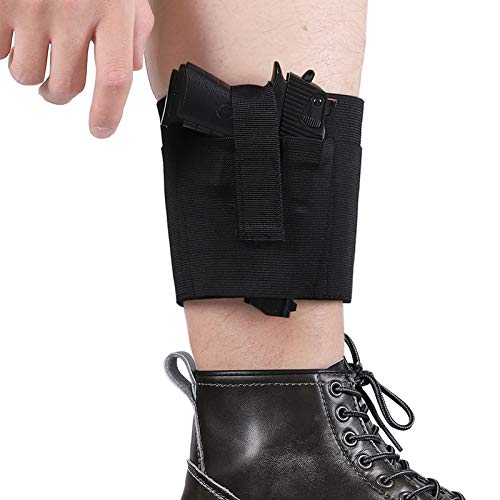
Accmor Ankle Holster for Concealed Carry, Elastic Deep Concealed Leg Holsters with Magazine Pocket/Pouch for Men and Women, Right & Left Hand Draw


As an Amazon Associate we earn from qualifying purchases. Product prices and availability are accurate as of the date/time indicated.
Prices shown are approximate and for reference only. Prices change often, so please check the current price on Amazon before you buy.
Verify your local knife carry law before purchase or carry. Fitments are knife-specific for molded sheaths; confirm your blade’s model. Ratings are editorial, weighing retention, all-day comfort and migration resistance, sheath safety, concealment profile, and value.
The Six Ankle Knife Options Reviewed
1. Galco Ankle Band Class: Best Comfort
Galco’s ankle platform leads on the virtue that retires its rivals, comfort across the full day: a wide neoprene calf band with sheepskin at the ankle bone in its class’s design, distributing the hold so the rig is forgotten by the second hour, which is the ankle carry’s definition of success. Its knife sheaths in the line are leather citizens fitted to the popular boot blades, their retention the material’s honest friction, audited as leather must be. For the carrier whose day is measured in miles and whose ankle has vetoed lesser rigs, it is the recommendation defended first, with the note that its platform also serves the small-handgun ankle world its maker is famous for, the knife buyer inheriting a maturity the knife-only brands cannot match.
2. Ka-Bar TDI System Class: Best Knife-and-Sheath
The TDI concept, a compact fixed blade drawn like a pistol grip’s cousin, arrives with a hard sheath designed for the body’s alternative carries, ankle among them with the rig’s addition, and it earns its row as the system’s thinker: blade, sheath, and carry designed together rather than assembled by hope. Its retention is the molded class’s positive hold, its profile is flat by intention, and its constituency, the professional backup carrier, is the ankle parish’s most serious citizen. For the buyer starting from zero, knife and rig as one decision, it is the coherent purchase, graded for a system whose designer understood that at the ankle, the draw is a geometry problem before it is a hardware one.
3. SOG and CRKT Boot Knife Class: Best Dedicated Boot Knives
The boot knife specialists serve the traditional carry in its own terms: slim fixed blades with molded or fitted sheaths, sold for the boot top and adaptable to the ankle rigs of this table, in steels and finishes across the working price band. Their sheaths’ clips and the rigs they pair with must be matched by the buyer with the steps’ care, the system’s retention being the combination’s rather than either part’s claim. For the carrier whose knife is a working tool that also rides at the ankle, the field’s and the boat’s constituency, they are the practitioner’s rows, and their grade reflects honest blades in honest sheaths at honest prices, which in this category is a complete sentence.
4. DeSantis Ankle Class: Best Leather Tradition
DeSantis brings the leather house’s hand to the ankle: rigs and sheaths in the material that molds to the blade and the leg together, silent at the draw, traditional in the hand, from a maker whose ankle platforms for the handgun world give its knife rigs their engineering inheritance. Its care is leather’s care, its retention audited on the season’s round as the material ages, and its comfort is the broken-in glove’s. For the traditionalist whose whole kit is leather and whose ankle rig must match in silence and in spirit, it is the considered row, graded at the top of its material’s class.
5. Compression Calf Sleeve Class: Best Anti-Migration
The compression sleeve rigs, the BugBite pattern being the class’s known name, answer the migration problem with a garment rather than a strap: a calf sleeve whose compression holds its pockets, knife among them, against the leg’s whole surface, distributing the carry so completely that the ankle bone is out of the negotiation entirely. Their sheaths are pockets rather than molded housings, which grades their retention below the leaders’ and their comfort above them, a trade their row states in this guide’s manner. For the carrier whose enemy is the rig’s travel rather than the draw’s drama, the nurse, the driver, the tradesperson whose day is motion, it is the specialist’s answer, and its presence keeps the table honest about which failure the buyer is actually shopping against.
6. Generic Elastic Ankle Sheaths: Best Rock-Bottom, With Conditions
The generic elastic rigs close the table at the floor’s price with the floor’s conditions printed plainly: a universal nylon sheath on an elastic strap, fitting most small blades and securing them by a strap’s snap or friction, adequate for the utility folder’s casual carry and the field’s short duties, and not this guide’s recommendation for a fixed blade’s all-day concealed carry, where the molded retention of the rows above is the safety argument entire. Their audit on arrival, the shake test and the strap’s stitching read as evidence, is the purchase’s second half, and their legitimate parish, the tackle box’s spare, the garden’s tool, the loaner’s rig, is a real one. Graded as the floor with its fences visible, they complete a table whose every other row exists because this one’s compromises were, for serious carry, declined.
Buying Guide: How to Choose and Wear an Ankle Knife Sheath Lawfully and Safely
Step One: The Law, the Knife, and the Rig, in That Order
Begin with the official text of your state and municipal knife law for the exact carry intended, blade type and length, concealment, mechanism, and place, and let the lawful envelope choose the knife before any rig is admired, since the finest ankle system in this table is a liability in a jurisdiction that prohibits its contents. Choose the knife by the ankle’s own physics: small, slim, flat, light, its handle printing like a tool and its blade in the class your law and your use agree on, with the molded sheath fitted to that exact model where the Kydex route is taken, since a molded sheath is a marriage certificate and not a dating arrangement. Choose the rig by your footwear and your day, the boot’s shaft or the shoe’s collar, the miles walked, the seated hours, each electing its row of the table more honestly than any brand’s claim, and order the whole as one system whose parts have been introduced to each other on paper before they meet on your leg.
Step Two: Fit and Rehearse With the Blade Respected
Fit the rig in the morning, on the leg and the footwear of the real day: strap snug above the ankle’s narrow, sheath flat and positioned by your school’s draw, inside of the opposite ankle or outside of the draw-side, the trouser’s drape audited in the mirror at standing, sitting, and the stair’s flexion, since the ankle rig prints in motion before it prints at rest. Test the retention over a bed, the rig shaken inverted, the knife’s hold positive, and rehearse the draw slowly, seated and standing, with the blade’s edge governed at every repetition and the return to the sheath performed by sight and by patience, never by a blind stab at the ankle’s neighborhood, the re-sheathing being the ankle carry’s most dangerous motion and the one its professionals perform with their eyes open and their trouser leg lifted clear. Walk the rig for a full day at home’s parish before the world is asked to host it, the migration, the hot spot, and the print all filing their reports where they can still be answered with a different row of the table.
Step Three: Carry, Store, and Maintain as a Responsible System
Run the carry inside the law’s whole map as Step One drew it, the prohibited places honored, the employer’s and the school’s rules read as law’s local dialect, and the knife treated in company as the tool it is, drawn for its tasks and not for its theater. At home, the knife and rig are stored as the household’s edged tools are stored, secured from children and unauthorized hands, the blade sheathed, in the place the household’s safety system assigns, never loose in a drawer of small hands’ archaeology. Maintain the system on the month’s round: the sheath’s retention re-tested by the shake, the leather conditioned or the Kydex’s screws checked by their material’s liturgy, the strap’s elastic read for the fatigue that announces itself as migration, and the blade kept clean and lightly oiled against the ankle’s humid climate, the carry position being, of all the body’s, the one whose weather is a sock’s. Kept so, the ankle rig becomes what its best citizens already are, an unremarkable piece of daily equipment, secure, silent, lawful, and forgotten by its wearer for the whole of the ordinary day, which is the only review that matters for a thing carried at the end of a leg, through ten thousand steps, in a world that never needed to know.
Frequently Asked Questions About Ankle Knife Holsters
Is ankle carry for a knife legal?
It depends on where you are, what the knife is, and how it is carried, with a locality that exceeds even the firearm world’s: many jurisdictions regulate concealed fixed blades as concealed weapons in their own right, some prohibit them outright, others fold them into a carry permit’s scope or leave them to blade-length and mechanism rules, and municipalities add their own layers over the state’s. The only responsible answer is the procedure of Step One, the official text for your state and city, read for your exact knife and your exact manner of carry, before the carry begins, with a permit obtained where the law offers one and the carry declined where it does not. Treat any source that gives a flat national answer, a product page above all, as a source that has not understood the question, and remember that the ankle is concealment by definition, so the concealed-weapon provisions are always the chapter to read first, a sentence this guide prints in every relevant article and means most in this one.
Is an ankle knife actually useful, or is it a movie prop?
Both reputations are earned, by different users: as a primary defensive draw for a standing person it is the slowest access on the body, a fact its honest advocates concede in their first paragraph, as this guide did in its own; as a working tool’s carry for the seated, the driving, the waistband-forbidden worker, and as a backup positioned for the fallen or the seated, it serves real constituencies whose days the waistband cannot accommodate, the delivery and medical and trades worlds among them. The utility knife at the ankle, the box cutter’s and the rope knife’s parish, is the carry’s least dramatic and most defensible citizen, opening the day’s hundred packages from a seated position without a pocket’s excavation. Judge the purchase by your own day’s geometry rather than by the cinema’s, buy it for the reach you actually perform, seated, at the end of a leg, and it will be a tool; buy it for a draw you have only seen performed, and it will be, as the question fears, a prop with a strap, at a price this table would rather you spent on the boots.
How do I stop an ankle rig from sliding down?
By treating migration as a fit problem with three addresses: the anchor, the rig riding above the ankle’s narrowest point with its strap or sleeve gripping the calf’s swell rather than the bone’s hinge, fitted snug in the morning against the day’s loosening rather than comfortable against the first hour; the footwear, the boot’s shaft giving the rig its wall, and the low shoe’s wearer choosing the sleeve class or the stirruped rig whose second anchor keys to the ankle itself; and the load, every ounce audited, since the pendulum’s arithmetic is merciless and the knife that is two ounces lighter will still be at its post at evening when the heavier has emigrated to the shoe. If a rig still travels after those three are honestly addressed, the rig, not the leg, is the finding, and the table’s comfort rows, the wide band and the compression sleeve, exist as the appeal court for exactly that verdict, since a carry that must be hitched up hourly is a carry that will be left in the drawer by the month’s end, where it protects nothing and complies with nothing.
What size knife is best for ankle carry?
The small and the flat, by the pendulum’s law and the trouser’s testimony: overall lengths in the six-to-eight-inch class for fixed blades, weights in the few-ounces parish, handles slim and smooth in profile, since every dimension of the ankle’s passenger is multiplied, in print by the drape’s honesty and in fatigue by the day’s ten thousand steps. The blade’s own length is chosen inside your law’s envelope first and your use’s second, the utility tasks of the ankle’s real constituency asking little of length and much of a handle that fills the hand from the awkward angles the position imposes. The sheath’s profile counts as part of the knife’s size for every purpose of this article, a slim blade in a bulky sheath being a bulky carry, which is why the molded classes grade above the universal pouches for the fixed blade’s role. Audition the whole system on the leg for the full day of Step Two before the verdict, since the ankle, like the waist, is a carry position whose truth is told by the evening and not by the mirror, and the knife that is still forgotten at the day’s end is, by the only measurement that has never lied to this guide, the right size.
Related guides
- Best LCP Ankle Holster in 2026: 6 Comfortable Ankle Holsters for the Ruger LCP
- Best Holster for Walther CCP M2 in 2026: 6 Concealed Carry Holsters for Comfort and Safety
- Best IWB Holster for P320 Compact: 6 Best IWB Holster for P320 Compact Picks in 2026
- Best SR22 Holster in 2026: How to Pick a Holster for Ruger SR22 That Is Safe, Comfortable, and Fits Your SR22 Perfectly
More from Amazon
Programs that pair well with the guide above. Offers and eligibility are set by Amazon and may change.
Free shipping on eligible items, Prime Video and more. Eligible new members can start with a free trial.
Start a Prime free trialAudiobooks and podcasts to listen to on the go. Eligible new members can start with a free trial.
Try Audible freeAd-free music streaming. Eligible new subscribers can start with a free trial.
Try Music Unlimited freeA free business account with business pricing and bulk-buying tools for work, shop or home office.
Create a business accountAs an Amazon Associate we earn from qualifying purchases.





Write Your Review
No reviews yet. Be the first to share your experience!