
What's inside
As an Amazon Associate I earn from qualifying purchases. This post may contain affiliate links at no extra cost to you.
The best level 3 retention holster is a duty holster with three distinct retention actions that must be defeated in sequence to draw, typically an automatic locking system at the ejection port or trigger guard area in the maker’s stated design, a rotating hood or strap over the back of the slide in the maker’s stated pattern, and moulded friction or a thumb release in the maker’s stated terms, fitted exactly to your pistol, light, and optic, mounted securely to a duty belt, and trained until the draw is one smooth motion rather than three separate problems. In current professional ranges that shortlist is dominated by Safariland’s ALS/SLS family, with Blackhawk’s T-Series L3D and Alien Gear’s Rapid Force Level 3 as the serious alternatives in their makers’ stated designs. This guide compares those real, currently sold level 3 holsters, explains what the retention levels actually mean and do not mean, and gives the fitting, mounting, and unloaded training routine that a level 3 holster demands before it is ever carried on duty or in any professional role. Carry only where and how the law, your agency or employer policy, and the rules of every place you enter allow, follow your organisation’s stated equipment and training standards where they apply to you, store the pistol at home unloaded in a locked container separate from ammunition and secure from children and every unauthorised person, and do all fitting, draw practice, and retention testing in this guide with the pistol completely unloaded, magazine removed, chamber checked visually and physically, and no ammunition in the room.
Level 3 is a term with a history and a misuse, and a professional buyer should hold both clearly. The retention level system began as a maker’s description of how many distinct actions or devices a holster required to be defeated before the pistol could be drawn, and it was widely adopted as a shorthand across the industry in the patterns trainers and agencies use, without ever becoming a single universal standard administered by one body in the way an ANSI rating is. That means two holsters both sold as level 3 in their makers’ stated terms may arrange their three actions differently, an automatic lock plus a hood plus friction in the Safariland school in this table, a thumb release plus a strap plus friction in another maker’s stated design, and the number alone certifies nothing about speed, security, or suitability for your role. What level 3 does reliably signal is intent: this is a holster for open, professional carry in settings where a gun grab, a fall, a vehicle exit, a foot pursuit, and close contact with the public in the roles these holsters serve are foreseeable events in an employer’s stated risk picture, and where the carrier is trained and practised to a standard that makes three actions one motion. It is not a concealed carry category, it is not a shortcut around training, and it is not automatically the right answer for every professional: many agencies and roles in their stated policies specify level 2 in its makers’ patterns as their balance of security and access, and the correct level for a given carrier is the one their law, policy, and training name. Rated on retention security under a genuine grab attempt in trained evaluation, then on draw consistency under stress, on exact fit for modern pistols with lights and optics in the makers’ stated fit lists, on mount security to a duty belt in the stated patterns, and on build across a career’s weather and vehicles, the rows below separate by ecosystem and by the hand they were designed around.
Prices are typical retail ranges and vary by pistol fit, light and optic options, belt mount, finish, retailer, and agency programme. Retention actions and their sequence, stated fit by exact pistol model, generation, light, and optic, shell material, mount patterns and belt widths, hood and guard options, and ride height and cant patterns are each maker’s stated details for the current version; a level 3 holster must be ordered for the exact pistol configuration it will carry, because its locking actions engage specific geometry that a near fit defeats.
Our Top Picks
 Level 3 Holster for Glock 17/19/19X/23/32/44/45Level 3 Holster1 x 6 x 6 inches0.3 poundsCheck on Amazon
What Makes the Best Level 3 Retention Holster Different
Three Actions, One Motion: How Level 3 Retention Actually Works
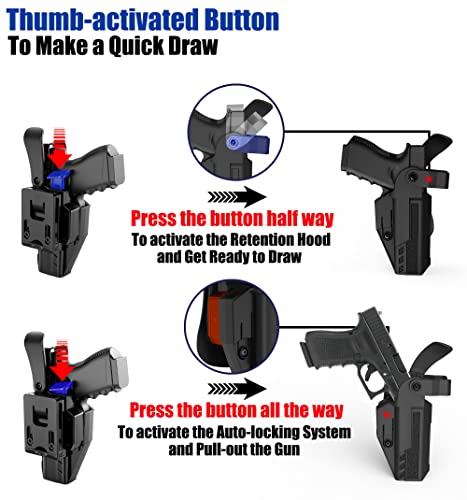
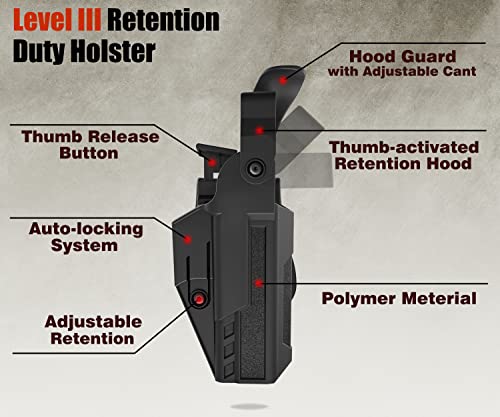
Understand the three actions as a sequence your hand performs, not as a count on a box. The first action in the dominant Safariland pattern in this table is the hood: the SLS rotating hood in the maker’s stated design sits over the back of the slide and must be pushed down and rotated forward in its stated motion before the pistol can move, which defeats a grab from behind or above in the geometry its designers intended and which a trained thumb performs as the hand lands on the grip. The second action is the automatic lock: the ALS in the maker’s stated design engages the pistol as it is holstered, locking at the ejection port area in the stated pattern, and releases by a thumb lever in the stated position between the holster body and the carrier’s body, pressed as the grip is taken, so the pistol is freed in the same motion that grips it. The third element is the moulded fit and friction in the maker’s stated design, the shell’s exact engagement with the pistol and light, which holds the pistol against movement until the draw’s straight line in the maker’s stated draw pattern pulls it clear. Other makers in this table arrange their three in their own stated sequences, Blackhawk’s T-Series in its stated thumb-driven pattern with its strap in its stated design, Alien Gear’s Rapid Force in its stated release and guard patterns, and the professional question is never which count is higher but whether the sequence, as a whole, can be trained to a single, gross-motor, repeatable draw that survives rain, gloves, a seatbelt’s geometry, and a heart rate the carrier did not choose. Any level 3 holster whose actions require fine motor searching, a button located by looking, a strap coaxed rather than driven, is a holster whose third level is a liability wearing a feature’s name, and the unloaded draw test in the buying guide exists to expose exactly that before a career does.
Fit for Lights and Optics: The Modern Duty Pistol Is a System
A level 3 holster is fitted to a system, not to a pistol name, and the system must be named completely before ordering. The pistol by exact model and generation in the maker’s stated fit list, the weapon light by exact model in the stated list, because the shell and its locking geometry in the makers’ stated designs are moulded and indexed around the light’s body on most current duty patterns, and the optic by its stated pattern, an enclosed or open emitter in its stated terms, with the holster’s optic cover or hood clearance in the maker’s stated design confirmed for it, since a hood that fouls a taller optic is a retention system fighting its own pistol. Write the full sentence, pistol, light, optic, hand, mount, belt width in the belt’s stated terms, and buy only the holster whose maker states that sentence whole, because a level 3 mechanism that almost engages is worse than an honest level 1: it promises a lock it does not deliver and it can bind a draw it was bought to protect. Consider the system’s near future in the same order, an agency’s planned light or optic change in its stated programme, a personal pistol’s likely upgrade in its stated patterns, since a holster fitted to today’s system may not fit tomorrow’s, and the makers in this table publish fit charts in their stated terms precisely so that a buyer can see the boundary before money crosses it. Mounting is the fit’s second half: a duty mount in the maker’s stated patterns, belt loop, quick locking fork and plate systems in the Safariland school in this table, and their counterparts in the other makers’ stated designs, rated and fitted to a proper duty belt in its maker’s stated construction, with the holster’s ride and cant set in the stated adjustments so the draw line in the maker’s stated pattern clears body armour, a jacket, and a vehicle seat in the carrier’s actual working kit, tested in the vehicle and the chair the job actually uses rather than only in a mirror.
Who Level 3 Is For, and Who It Honestly Is Not
Level 3’s honest constituency is the open professional carrier whose role and policy foresee contact: uniformed law enforcement in their agencies’ stated equipment policies, armed security in their employers’ stated standards, corrections, transport, and site roles in their stated terms, and other professional carriers whose organisations name the level in their stated patterns. For those carriers the holster is one part of a system that includes weapon retention training in their programme’s stated curriculum, because a holster’s three actions buy seconds and a trained carrier is what those seconds are for, and no holster in this table is a substitute for the grappling, awareness, and positioning skills that prevent the grab the holster resists. The honest exclusions matter as much. A concealed carrier gains nothing from level 3 and loses concealment, comfort, and draw simplicity to it, and should shop the concealed schools in this site’s other guides. An untrained carrier, however professional their role, is made slower and less safe by three actions they have not drilled, and for them the purchase order is training first, holster second, in that sequence without exception. A carrier whose policy specifies a level or a maker in its stated terms has no shopping decision to make, only a fitting one, and this guide’s fitting and training sections are written for them as much as for the free chooser. Finally, a level 3 holster carried outside any professional context, openly where the law allows in its stated terms, is a lawful choice in some places and a considered one in few, since its size, its mount, and its training demands argue that its owner has a role that justifies them; the law where you are, and not this guide, is the authority on where and how any holster may be carried.
Quick Comparison: Best Level 3 Retention Holster Models
| Model | Retention Actions, Fit and Key Specs in Maker’s Terms | Best For | Typical Price Range | Rating |
|---|---|---|---|---|
| Safariland 6360RDS ALS/SLS class | Level 3 in maker’s terms, ALS lock and SLS hood stated | Best level 3 retention holster overall | $150 – $230 by fit and mount | 4.7 / 5 |
| Safariland 7360RDS 7TS ALS/SLS class | Level 3 in maker’s terms, 7TS shell patterns stated | Best level 3 retention holster for harsh weather | $140 – $210 by fit and mount | 4.6 / 5 |
| Blackhawk T-Series L3D class | Level 3 in maker’s terms, thumb release patterns stated | Best level 3 retention holster for thumb-driven draw | $130 – $190 by fit and mount | 4.4 / 5 |
| Alien Gear Rapid Force Level 3 class | Level 3 in maker’s terms, release and guard patterns stated | Best level 3 retention holster for adjustability | $130 – $190 by configuration | 4.3 / 5 |
| Safariland 6390RDS ALS class | Mid-ride ALS patterns in maker’s terms stated | Best level 3 base for ALS users stepping up | $110 – $170 by fit and mount | 4.4 / 5 |
| Safariland 6280 SLS class | SLS hood patterns in maker’s line terms stated | Best level 3 retention holster in the classic SLS school | $120 – $190 by fit and finish | 4.2 / 5 |
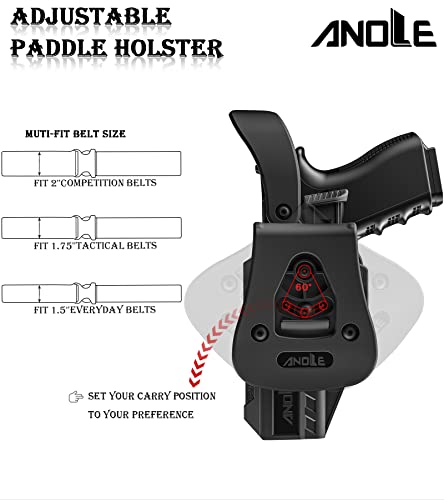
Level 3 Holster for Glock 17/19/19X/23/32/44/45, Right-Handed | OWB Paddle Holster, Adjustable Retention, Auto Lock Thumb Release, Duty Open Carry




As an Amazon Associate we earn from qualifying purchases. Product prices and availability are accurate as of the date/time indicated.

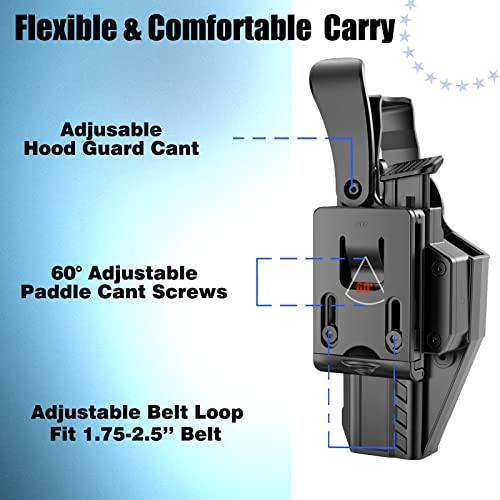
G19 Level 3 Retention Duty Holster for Glock 19/17 Gen 1 2 3 4 5, Glock 23/32 Gen 1 2 3 4, Glock 45/44/19X, Law Enforcement Duty Holster, Adjustable Retention/Cant Duty Belt Gun Holster - Right Handed



As an Amazon Associate we earn from qualifying purchases. Product prices and availability are accurate as of the date/time indicated.

Rapid Force Level 3 Duty Holster – Compatible with Glock 17/17 MOS/19/19X/19 MOS/23/22/44/45/ 45 MOS/47/47 MOS – Right Hand – Large Light – Mid Ride – Matte Black – No Axon – Optic Ready
As an Amazon Associate we earn from qualifying purchases. Product prices and availability are accurate as of the date/time indicated.
Retention sequence and actions, stated fit by exact pistol, light, and optic, shell material and lining patterns, mount systems and belt widths, hood guard and optic cover options, and ride and cant adjustments are each maker’s stated details for the current version and configuration. Price ranges are typical retail ranges and vary by options, finish, retailer, and agency programme. Ratings are editorial ratings for professional open carry specifically: retention security and sequence trainability in class, exactness of stated fit for light and optic systems, mount security on a duty belt, durability across vehicles and weather, and depth of agency and support ecosystem.
Detailed Reviews: Best Level 3 Retention Holster Picks
1. Safariland 6360RDS Class – Best Level 3 Retention Holster Overall
The 6360RDS pattern is the modern duty standard against which the category is judged: ALS automatic lock and SLS rotating hood in the maker’s stated designs performing the three actions as one trained motion, RDS patterns in the stated terms fitted for the current generation of duty optics and lights in the maker’s stated fit lists, and a mount ecosystem in the stated patterns, forks, plates, and belt systems in their stated designs, that lets an agency or a carrier build a whole belt around it. Its draw rewards exactly the training this guide prescribes and punishes its absence just as exactly. For a professional choosing freely, this is the row the profession itself chose.
2. Safariland 7360RDS Class – Best for Harsh Weather
The 7360RDS brings the same ALS/SLS sequence in the maker’s stated designs to the 7TS shell school in its stated material patterns, whose behaviour in water, cold, and abrasion in the maker’s stated terms suits the carrier whose duty is outdoors in the weather’s own terms, boats, bikes, northern winters, and desert vehicles in their stated service patterns. Fit lists in the maker’s stated terms cover the current light and optic systems as its sibling does. For the professional whose holster will be rained on more than it will be admired, this is the working row.
3. Blackhawk T-Series L3D Class – Best for a Thumb-Driven Draw
Blackhawk’s T-Series L3D arranges its retention around a thumb-driven release in the maker’s stated design, with its additional retention elements in their stated patterns, in a shell in the stated construction whose draw motion its users describe in aggregate as a single press-and-draw learned quickly in unloaded training. It serves the carrier whose hand and whose organisation’s stated standards suit its pattern, assessed exactly as its maker directs. As with every release design, its verdict is earned in the buyer’s own drilled, unloaded repetitions rather than in any listing, and this guide’s test below is its proper examination.
4. Alien Gear Rapid Force Class – Best for Adjustability
Alien Gear’s Rapid Force Level 3 is the modular entrant: retention actions in the maker’s stated patterns with an emphasis on adjustable and configurable elements in their stated designs, mounts and ride patterns in the stated terms that let a carrier tune the system to a belt and a vehicle, and fit patterns in the stated lists for the common duty pistol and light systems. It suits the security professional and the agency in its stated programmes whose needs the dominant ecosystem’s fixed patterns fit less exactly. Bought with its configuration set deliberately and then left alone, it is a serious professional tool.
5. Safariland 6390RDS Class – Best ALS Foundation
The 6390RDS pattern, the ALS school in its mid-ride stated design, is included as the foundation many level 3 carriers actually train from: the same automatic lock language in the maker’s stated terms, in a holster whose stated retention configuration sits at the boundary agencies describe in their stated policies, and to which the hood elements in the maker’s stated patterns complete the level 3 system in the configurations its maker states. A buyer should confirm the exact configuration’s stated retention level in the maker’s own terms for their policy’s requirement, which is this guide’s standing rule for the whole category. As a training and transition step into the ALS/SLS draw, it is the profession’s own staircase.
6. Safariland 6280 SLS Class – Best in the Classic SLS School
The 6280 SLS pattern is the classic self-locking hood school in the maker’s stated design, the holster a generation of officers learned on, with its rotating hood in the stated pattern, suede and finish options in the stated line terms, and fit patterns in the stated lists for the duty pistols of its long service. Newer RDS patterns in this table serve optics and lights more completely in their stated terms, and the 6280’s seat here is for the carrier whose pistol, policy, and training in their stated terms are built around it. Continuity is a real professional value, and this row is its address.
Buying Guide: Choosing the Best Level 3 Retention Holster
Confirm Policy, Name the System, and Order the Exact Fit
Begin with authority rather than with a catalogue: your law, your agency or employer’s stated equipment policy, and your training programme’s stated standards name the retention level, and in many services the maker and model family, that you are authorised to carry, and a holster bought outside that authority is a uniform violation with a receipt. Within the authority, name the system in writing as this guide’s fit section teaches: pistol by exact model and generation, light by exact model, optic by exact model and its stated height pattern, hand, mount system in its maker’s stated pattern, and duty belt by its maker and stated width and construction, and order only the holster whose maker states that whole sentence, through a supplier whose stated returns accommodate the fitting failures that even careful ordering occasionally produces. Budget the system whole: holster, mount and any quick-detach patterns in their stated designs, a duty belt built for the load in its maker’s stated terms, magazine and equipment pouches in their stated patterns arranged so nothing fouls the draw, and the training ammunition and range time in your programme’s stated terms that the draw’s education consumes, because a level 3 holster’s true price includes the repetitions that make it safe, and a budget that starves them has bought the risk without the skill.
Prove It Unloaded: The Draw, the Grab, the Vehicle, and the Glove
The proof is a procedure and it is done with no ammunition in the room, the pistol verified unloaded, magazine removed, chamber checked visually and physically, and where your programme uses them, an inert training pistol in its maker’s stated pattern matched to the holster’s fit. Run the checklist in order. Retention: with the pistol seated and all actions engaged in their stated patterns, the holster holds through shake, inversion over a soft surface in the careful pattern, a partner’s honest grab attempts from front, side, and rear in the supervised training patterns your programme states, and the carrier’s own retention response in its stated curriculum, because the holster and the technique are graded together. Draw: from the full working kit, belt, armour, jacket in the season’s terms, the draw performed slowly, then at training speed in your programme’s stated progression, one hundred repetitions counted, with every failure, a hood fumbled, a lock missed, a bind against the light or optic, recorded rather than excused, since a failure rate visible unloaded is the only kind you get to fix cheaply. Contexts: the draw and reholster from the driver’s seat with a seatbelt in the vehicle’s own geometry, from a chair, on stairs in the training setting’s stated patterns, and with the gloves your duty actually issues in their stated terms, because a sequence that requires bare fingers in January is a fair-weather system. Reholstering: slow, deliberate, with the carrier looking the pistol into the holster in the training pattern every competent programme teaches, the hood and lock re-engaged and verified by feel and by tug in the stated pattern, every time, without exception for hurry. A holster and a carrier that pass the whole procedure have earned duty; any element that fails returns to fitting, adjustment in the maker’s stated patterns, or training, and the carrier does not carry the system publicly until it passes whole.
Maintain the Mechanism, Retrain on Every Change, and Retire on Evidence
A level 3 holster is a mechanism, and mechanisms are maintained. Keep its moving parts, hood pivot, lock lever, and release patterns in their makers’ stated terms, clean in the makers’ stated care patterns, free of the grit, lint, and dried weather a duty belt collects, and test its full sequence unloaded after every cleaning, after any drop or vehicle incident in the honest pattern, and at the rhythm your programme states, because a retention device that fails silently has failed in its only job. Screws and mounts in their stated patterns are checked against their fitted state on the same rhythm, with thread treatments only as their makers state, and the belt itself in its maker’s stated terms inspected for the stretch and wear that change a draw’s geometry by degrees. Retrain formally whenever any element of the system changes, a new pistol, light, optic, mount, or holster in their stated patterns, a change of hand position or kit layout in your programme’s terms, because the draw you own belongs to the combination you drilled, and a changed combination is a new skill at its first repetition whether its owner admits it or not. Retire the holster on evidence: a hood or lock that no longer engages positively in its stated pattern, a shell cracked or worn at a locking surface in the inspection pattern its maker states, a release that has begun to stick or to free itself, each a same-day verdict executed through the maker’s or agency’s stated channels, since a retention holster’s value is entirely the certainty it provides. At home, the system stands down as this guide has said throughout: pistol unloaded, locked, separate from ammunition, secure from every unauthorised hand, the holster stored with the duty belt as equipment and never as a container for a stored pistol. Run that discipline, policy confirmed, fit exact, and the draw drilled until it is one motion in the rain, in gloves, in a vehicle, and the best level 3 retention holster becomes what its best carriers describe: three locks you never think about, between your pistol and a world that occasionally reaches for it, and a draw that arrives, every time, as if there were none.
Frequently Asked Questions About Best Level 3 Retention Holster
What is the best level 3 retention holster?
Safariland’s 6360RDS ALS/SLS is the best all-round answer and the modern duty standard, with the 7360RDS 7TS version for harsh weather, Blackhawk’s T-Series L3D the thumb-driven alternative, and Alien Gear’s Rapid Force the adjustable system. In every case the best is the holster your law and your agency or employer policy authorise, whose maker states the exact fit for your pistol, light, and optic as one sentence, and whose full retention sequence you have proved, completely unloaded, through a hundred counted draws in your full kit, in a vehicle, and in gloves, before carrying it professionally. A level 3 holster is a trained system, and the training is part of the product.
What does level 3 retention actually mean?
It means the holster requires three distinct retention actions or elements to be defeated in sequence before the pistol can be drawn, in the maker’s stated design, commonly an automatic lock that engages on holstering, a rotating hood or strap over the slide, and the moulded fit and friction of an exact shell, as the Safariland ALS/SLS pattern in this table arranges them. It is an industry shorthand that began with one maker’s system rather than a single universal standard, so two level 3 holsters can arrange their actions differently, and the number alone does not certify a specific test or guarantee a specific draw speed. Judge a level 3 holster by its actual sequence, its stated fit, and your drilled performance with it, and by your policy’s stated requirement, not by the numeral.
Is a level 3 holster too slow to draw from?
An untrained level 3 draw is slow, and a trained one is not, and that difference is the category’s central fact. The dominant ALS/SLS sequence in this table was designed so the hood and the lock are defeated by the same hand motion that takes the grip, thumb driving the hood as it lands and pressing the lock as it closes, so a carrier who has drilled the sequence unloaded in their programme’s stated progression draws with a delay measured in fractions rather than in fumbling. A carrier who has not drilled it will fumble it under stress with a reliability no one should test in public. Buy the training with the holster, count your repetitions, test in gloves, armour, and a vehicle as this guide prescribes, and let your own recorded performance, not a video or a listing, answer the speed question for your hands.
Can I use a level 3 holster for concealed carry or general use?
It is the wrong tool for concealed carry and an oversized one for most general use, and the reasons are practical rather than doctrinal. A level 3 duty holster in its maker’s stated design is large, rides on a duty belt in its stated mount patterns, is built to be seen and grabbed at rather than to disappear, and asks a training investment that concealed carry’s simpler passive and level 1 and 2 schools in their makers’ stated patterns do not require for their different risk picture. Where open professional carry is your role and your policy names the level, level 3 is the correct and considered choice. Where it is not, choose the holster school built for your actual carry, from this site’s concealed and range guides, and store and carry within the law where you are in every case.
Related guides
- Best Vertical Shoulder Holster: 6 Vertical Shoulder Holsters for 2026
- Best Holster for Colt Commander in 2026: 7 Best Holsters for Colt Commander That Fit the 1911, Protect the Trigger, and Carry Comfortably
- Best Holster for Taurus G3C with Laser in 2026: Vedder, CrossBreed, and CYA Graded on Moulding to Your Exact Laser, Full Trigger Coverage, and the Activation Switch’s Parish
- How to Choose Gun Safe Lock in 2026: 7 Best Gun Safe Locks With Clear Security, Simple Use, and Easy Use for Gun Safes
More from Amazon
Programs that pair well with the guide above. Offers and eligibility are set by Amazon and may change.
Free shipping on eligible items, Prime Video and more. Eligible new members can start with a free trial.
Start a Prime free trialAudiobooks and podcasts to listen to on the go. Eligible new members can start with a free trial.
Try Audible freeAd-free music streaming. Eligible new subscribers can start with a free trial.
Try Music Unlimited freeA free business account with business pricing and bulk-buying tools for work, shop or home office.
Create a business accountAs an Amazon Associate we earn from qualifying purchases.

Write Your Review
No reviews yet. Be the first to share your experience!